

IT managers deploying enterprise AI voice recorders in 2026 face a critical hardware and governance challenge, not just a software update. Employees are already bringing unauthorized consumer AI wearables into confidential meetings to avoid typing. This unauthorized recording is an IT compliance vulnerability waiting to happen. Rolling out an enterprise AI voice recorder deployment requires dedicated hardware ecosystems, strict Mobile Device Management (MDM), and localized Zero-Trust Data Flow. Relying on third-party cloud bots is a structural risk.
This playbook covers why bot-based notetakers are obsolete, how to implement a Sovereign Voice architecture, and the execution of a 3-Pillar Rollout Framework—Fleet Governance, Acoustic Etiquette, and Organizational Intelligence—for deployments exceeding 50 employees.
The Structural Risk of Bot-Based Meeting Transcribers
Why Third-Party Cloud Software Fails Enterprise Audits
Third-party meeting bots fail enterprise audits because they export proprietary audio data to external servers for processing. Leading enterprise platforms now mandate zero-data retention by default on AI workflows, utilizing regional cloud hosting and requiring strict compliance certifications including ISO 27001, SOC 2 compliance for corporate voice transcription, GDPR, HIPAA, and EN 18031 to prevent corporate data from being ingested into consumer LLMs.
Gartner projects that by the end of 2026, 40% of enterprise applications will include task-specific AI agents, but 40% of agentic AI projects will be canceled by 2027 due to governance gaps. The primary governance gap is the reliance on invited software bots that inherently break data sovereignty.
Consent Fatigue and Unauthorized Shadow AI
Software bots trigger "consent fatigue"—the operational friction of repeatedly asking for or granting recording permissions in daily enterprise interactions. To bypass this friction, employees purchase personal AI hardware.
According to Unseen Security's "The State of Shadow AI 2026" (citing the IBM Cost of a Data Breach Report 2025), 59% of employees currently use unauthorized "Shadow AI" at work, with 47% accessing generative AI through personal accounts. Consequently, Shadow AI data breaches now cost enterprises an average of $670,000 extra per incident. Organizations must deploy managed hardware to preempt the use of unmanaged consumer devices.
Securing Data During Enterprise AI Voice Recorder Deployment
Building Sovereign Voice Architecture
Securing voice data requires moving processing from public clouds to localized infrastructure. In visual architectural breakdowns of enterprise deployments, Fred Fontes, CEO of Acclaim, contrasts the flawed "Cloud Web" model against the "Sovereignty" model.

In the Cloud Web model, an enterprise sends voice data to a cloud provider, who routes it to dozens of sub-providers for Automatic Speech Recognition (ASR), Large Language Models (LLMs), and Text-to-Speech (TTS). Fontes notes that IT leaders are often stuck "between a rock and a hard place of 'I must innovate and I must introduce AI, but the only way today I have to do so is by sending my data to a third provider... who's then sending that data to their providers.'"
Conversely, the Sovereignty model deploys the entire AI stack entirely within the enterprise's own infrastructure, maintaining strict data compliance.
Avoiding the API Integration Pitfall
A common architectural mistake is attempting to build a voice AI solution by stitching together various off-the-shelf APIs. Experts point out that this approach creates a massive challenge for change management, technical deployment, enterprise AI transcription security & compliance, and long-term maintenance.
Furthermore, relying on third-party APIs incurs compounded transactional fees across the ASR, LLM, and TTS layers. According to Latenode Enterprise Adoption & Procurement Data (2025/2026), consolidating fragmented AI API subscriptions into a single, unified multi-model platform reduces enterprise AI infrastructure costs by 40% to 60%. Owning the stack or utilizing an end-to-end platform is the definitive path to cost reduction.
Pillar 1: Centralizing Fleet Governance and Hardware Management
Transitioning to Zero-Trust Data Flow
The 2026 standard for enterprise AI requires strict "Zero Data Retention" (ZDR) policies—ensuring no audio or transcript data is retained or used for model training—paired with Enterprise Key Management (EKM) for localized cryptographic control. Consumer devices lacking EKM and ZDR are structurally unfit for enterprise deployment. Hardware ecosystems must guarantee that local recordings are encrypted at rest and in transit before hitting the enterprise server.
Mobile Device Management for Physical Voice Recorders
Deploying physical recorders requires centralized billing and remote-wipe capabilities.

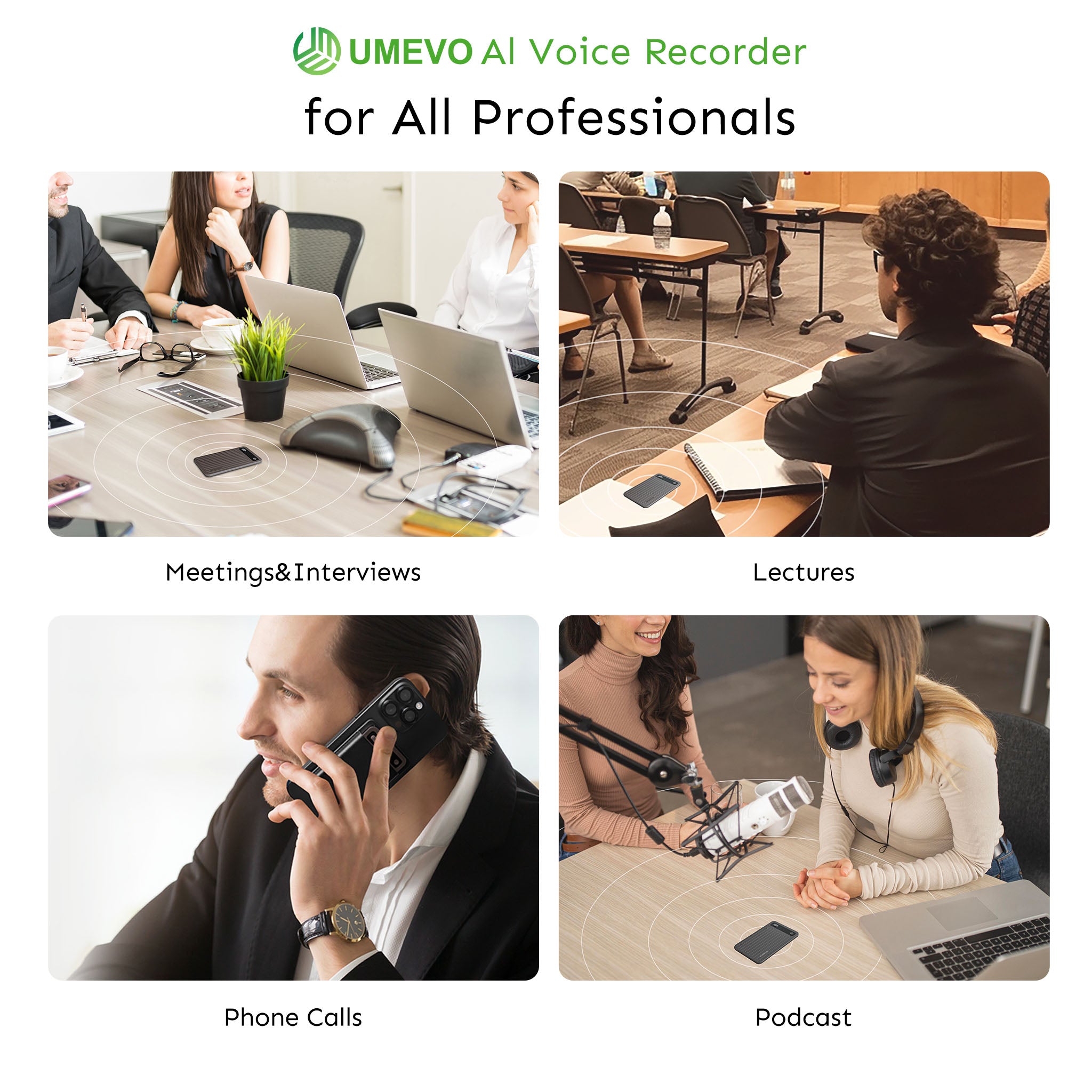
The Plaud Team remains the industry standard for out-of-the-box team billing, and is an excellent choice for organizations prioritizing centralized subscription management. However, for field teams who prioritize offline telephony capture without recurring monthly API fees, the UMEVO Note Plus offers a more cost-effective path. It utilizes vibration conduction sensors attached magnetically to smartphones to capture direct telephony audio without triggering software-level recording permissions. Regardless of the hardware chosen, IT must govern the resulting local files via MDM to prevent unauthorized data offloading.
📺 Mobile Device Management Configuration and Setup | Intune ...
Enterprise MDM Configuration Checklist for Voice Hardware
To ensure compliance across a 50+ employee deployment, IT managers must verify the following configurations before issuing physical recording devices:
- Device Enrollment: Hardware is registered to the corporate MDM profile prior to distribution.
- Storage Encryption: AES-256 encryption is forced on the device's local storage (e.g., securing the 64GB internal drive).
- Data Offload Restrictions: USB mass storage transfer to non-corporate machines is disabled.
- Remote Wipe Capability: IT retains the ability to format the device remotely if lost or stolen.
- Network Whitelisting: Wi-Fi or Bluetooth syncing is restricted to corporate networks or approved enterprise companion apps.
Pillar 2: Mitigating Acoustic Stress in Open-Plan Environments
Establishing Low-Volume Dictation Protocols
Deploying voice AI to 50+ employees in an open-plan office introduces "Acoustic Stress"—the overlapping noise of simultaneous voice commands. Users on community forums often report that unmanaged dictation creates a hostile work environment.
Organizations must transition to low-volume dictation protocols. This requires deploying highly sensitive bidirectional noise-canceling hardware and open-ear AI headsets that allow employees to speak softly while the microphone isolates their vocal frequencies from ambient desk noise.
Audio Editing Commands and the Dictation Override Feature
Acoustic stress is exacerbated when employees repeat themselves to correct transcription errors. Training employees on specific voice editing commands reduces this friction. The "Actually Override" feature allows users to say a keyword to seamlessly delete and rewrite a flubbed sentence mid-thought, preventing the need to manually edit transcripts or loudly repeat entire paragraphs.
Pillar 3: Scaling the Organizational Intelligence Layer
Overcoming User Adoption Friction with Prompt Templates
Adoption friction occurs when employees successfully record a meeting but freeze up because they do not know how to prompt the AI to extract the right workflow data.

The UMEVO Note Plus is not designed for organizations that require real-time, multi-speaker cloud syncing across global offices. If your primary goal is live collaborative editing, you are better off with a cloud-native software bot. However, for teams that struggle with prompt engineering on local files, hardware ecosystems that offer Custom Summary Templates tailored to specific industries provide a structured path to adoption. Pre-configured templates (e.g., structured Meeting Minutes or medical SOAP notes) bypass the prompt engineering phase entirely.
Connecting the Final Stage of Legacy Robotic Process Automation
Voice AI serves as the final integration point for existing enterprise automation. In visual stress tests and architectural reviews, Fontes explains exactly why legacy Robotic Process Automation (RPA) failed to deliver its ultimate promise.
"The challenge that we've seen with legacy automation is it has never really connected the last mile," Fontes states. "We've managed to automate chunks of the process... but at some point, you always needed to effectively go to a human-to-human interaction to finally close the loop." Localized voice AI completes this loop, driving automated actions directly to the consumer without human middlemen.
Benchmarking Accuracy for Enterprise Telephony
A critical error in deployment is benchmarking AI voice accuracy against generic datasets. Fontes points out that being able to transcribe high-quality YouTube audio perfectly is irrelevant for an enterprise. IT managers must benchmark transcription accuracy against the exact medium and domain they will use. For example, testing the hardware's ability to transcribe low-fidelity telephony lines discussing highly specific banking topics yields the only relevant accuracy metric.
Measuring True Return on Investment for Voice Deployments
Shifting Metrics from Job Elimination to High-Touch Retention
A common mistake in deployment strategy is assuming the ROI comes strictly from laying off human agents. Fontes notes that the real value comes from taking burned-out, underpaid employees who "count seconds" and refocusing them on high-value interactions. In banking collections, for instance, AI achieved a 6-8% higher recovery rate, while humans were freed up to focus on high-touch retention that drives Customer Lifetime Value.
Conclusion
Successful enterprise voice deployment replaces shadow IT with secure, sovereign hardware. Controlling the hardware, the acoustics, and the local data stack guarantees long-term compliance and actual workflow automation. By shifting away from third-party cloud bots and implementing strict MDM governance over physical recording devices, IT managers can safely scale voice AI across 50+ employees without compromising proprietary data.
Frequently Asked Questions
What is Shadow AI Recording and how do we prevent it?
Shadow AI Recording occurs when employees use unauthorized, consumer-grade AI wearables or personal accounts to record confidential meetings. Prevent it by issuing corporately managed, MDM-compliant voice hardware that utilizes Zero-Trust Data Flow.
What are the ISO 27001 requirements for enterprise voice AI hardware?
ISO 27001 compliance for voice AI mandates TLS 1.2 (or higher) encryption for voice streams in transit, AES-256 encryption for stored recordings, strict Role-Based Access Control (RBAC), and automated regex-based redaction of PII/PCI from transcripts.
How does Sovereign Voice differ from standard cloud AI transcription?
Standard cloud transcription sends audio data to external third-party APIs for processing. Sovereign Voice deploys the entire AI stack (Speech-to-Text, logic, Text-to-Speech) entirely within the enterprise's own infrastructure to maintain strict data compliance.
How do you manage overlapping dictation noise in an open office?
Manage acoustic stress by deploying highly sensitive bidirectional noise-canceling hardware, enforcing low-volume dictation protocols, and training staff on seamless voice editing commands to prevent repetitive speaking.
Why is API stitching considered a security risk for enterprise voice data?
Stitching together off-the-shelf APIs passes sensitive enterprise voice data through multiple unseen third-party vendors, breaking data sovereignty and introducing severe compliance risks for regulated industries.





0 comments