

Procurement teams purchasing AI voice recorders frequently encounter severe subscription fatigue when their initial free transcription minutes expire. The standard 24-month AI voice recorder total cost of ownership for a heavy user processing 1,500 minutes per month on a Tier-1 device is roughly $360. However, when factoring in physical loss, the necessity of secondary backup recorders, and compliance liabilities, the true 3-year operational cost frequently exceeds $600. This analysis audits the hidden operational costs of AI voice hardware to provide accurate long-term financial forecasting.
Calculating Financial Versus Operational Total Cost of Ownership
Operational total cost of ownership extends beyond the initial purchase price and monthly software fees by incorporating hardware replacement risks, secondary backup equipment, and data privacy liabilities over a 36-month lifecycle.
Defining the True Cost Formula
Standard tech reviews calculate cost by adding the hardware manufacturer's suggested retail price (MSRP) to the annual subscription fee. This formula is incomplete. A highly accurate financial model requires a proprietary framework: Hardware MSRP + Subscription Fees + Secondary Hardware Requirements + Replacement Risk + Privacy Liability = True Operational TCO.
The Shift in the 2026 Market
The digital voice recorder market is projected to reach $2.15 billion in 2026, driven by the convergence of hardware and artificial intelligence. According to Skywork AI Projections (March 2026) and a detailed AI voice recorder price comparison 2026, the market is undergoing a massive shift toward Edge Processing. In 2024, 90% of devices were Cloud-dominant. In 2026, the market has shifted to a 50/50 Hybrid model, with projections indicating 80% Edge-dominance by 2028.
Consequently, the baseline financial calculation is being disrupted. New 2026 entrants are utilizing lifetime starter plans to undercut recurring costs. For example, the Comulytic Note Pro ($158.99) offers unlimited AI transcription and summaries free for life, while the UMEVO Note Plus ($169.00) includes a free first year of unlimited AI services. This shift forces buyers to evaluate whether they are paying for hardware, or simply paying a down payment on a software subscription.
Evaluating Subscription Tiers and Freemium Limitations
Freemium subscription tiers on AI voice recorders strictly cap monthly usage, forcing professionals into expensive annual contracts once they exceed basic transcription limits.
Analyzing Hard Limits on Free Tiers
The Plaud Note ($159) and NotePin ($159–$169) include a free Starter Plan strictly capped at 300 minutes per month. Heavy users must upgrade to a Pro plan (approximately $99.99/year for 1,200 minutes/month) or an Unlimited plan ($239.99/year). Users on community forums often report frustration with the "Hybrid Free Tier Rollover," discovering that unused freemium minutes do not roll over to the next month.
📺 Wearable AI Notetaker Showdown: $50 vs $400 Tested
The Feature Paywall Reality
Furthermore, free tiers frequently restrict core functionality. Visual stress tests confirm that while devices offer 300 free minutes, users cannot utilize advanced features like "Ask AI" or chat with their transcripts without upgrading to a paid Pro plan. This creates a subscription dependency, where the hardware loses its primary value proposition without ongoing payments.
Bypassing Hardware Subscriptions
Real-world testing suggests a highly effective TCO workaround: bypassing proprietary AI hardware entirely. Users can search for the best no-subscription AI voice recorders 2026 or purchase a budget EVISTR digital voice recorder for $13.97 to $33 upfront with zero recurring fees. By recording locally via USB and uploading the MP3s to third-party software like Otter.ai ($8.33/month), Descript ($12/month), or ElevenLabs (free for 2.5 hours/month), professionals detach their hardware costs from expensive, proprietary AI subscription ecosystems.
Assessing Hardware Replacement Risks and Battery Degradation
Miniaturized AI voice recorders carry a high probability of physical loss and rapid battery degradation, requiring buyers to factor replacement costs into their three-year financial models.
Form Factor Vulnerability
The Limitless Pendant costs $99 upfront (plus a $19/month Pro plan) and features a 100-hour battery life. However, its quarter-sized, screenless magnetic clasp design makes it highly susceptible to physical loss. In visual stress tests, reviewers demonstrate the awkward "collar sag" caused by the heavy magnetic pendant pulling down standard t-shirts. Furthermore, experts point out the physical replacement risk; one reviewer admitted at the 12:50 mark of a recent field test, "I'm sort of ashamed to admit this, but I lost it... A lot of these things are small and easy to lose."
Accidental Activation and Battery Drain

Hidden operational costs also include accidental activation. The Plaud NotePin activates via a touch-and-hold vibration. In field tests, this mechanism accidentally triggered inside a backpack, resulting in hours of muffled audio and a completely dead battery prior to a conference.
Wearability and Proprietary Accessories
Conversely, credit-card-sized devices mitigate this loss risk. The Comulytic Note Pro measures just 0.12 inches thick and boasts a 45-hour continuous recording battery life with 107 days of standby time.

While smaller pins offer practical wearability via watch band accessories, users must account for the hidden $20 replacement cost when proprietary charging cables inevitably break.
Analyzing the Impact of Hardware Active Noise Cancellation on AI Transcripts
Aggressive hardware-level active noise cancellation degrades the specific acoustic frequencies that large language models require for accurate speaker diarization and transcription.
The Hardware Active Noise Cancellation Reality

While many guides suggest purchasing recorders with strong Active Noise Cancellation (ANC), professional workflows actually require high raw Signal-to-Noise Ratio (SNR) without hardware compression. Hardware ANC creates a "3dB Cliff"—the exact drop-off point where LLMs fail to transcribe.
Signal-to-Noise Ratio Requirements
When hardware chips compress audio before the AI processes it, the software begins "hallucinating a summary" by inventing meeting notes to fill the acoustic gaps. Modern models like Whisper V3 or Claude 3.5 rely on uncompressed audio to separate distinct speakers.
Secondary Hardware Requirements

This inaccuracy introduces a secondary hardware requirement, often referred to by audiophiles as the "Backup Tax." Transcription failure rates for budget AI recorders in complex environments reach up to 25%. Consequently, professionals are forced to spend an additional $128 on reliable traditional recorders like the Sony UX570. The UX570 features high-sensitivity S-Microphones with Auto Voice Recording that optimizes vocal frequencies in Linear PCM and MP3 formats, guaranteeing audio capture when Bluetooth AI devices fail.
Software Reliability Variances
Software reliability also dictates operational costs. At 03:06 in a recent visual stress test, the Compass app completely failed, endlessly loading for over 20 minutes after a 45-minute recording without generating a transcript. In contrast, the Plaud app features a highly polished interface that visually breaks down recordings into timelines and interactive mind maps, justifying its higher software premium.
Evaluating Data Privacy Liabilities and Cloud Processing Constraints
Cloud-based AI voice recorders introduce severe corporate compliance liabilities, making on-device edge processing a mandatory requirement for legal and medical professionals.
Edge-AI Versus Cloud AI Infrastructure
The distinction between Edge-AI and Cloud AI defines the privacy liability of a device. Edge processing handles the audio transcription directly on the local hardware, whereas Cloud AI transmits raw audio files to third-party servers for processing.
Compliance Liabilities
Sending raw audio to third-party servers introduces a privacy liability. If a budget cloud-based AI recorder violates GDPR or HIPAA compliance due to opaque Terms of Service, the resulting corporate liability far exceeds the hardware's purchase price.
Continuous Recording Vulnerabilities
Furthermore, devices lacking clear user interface indicators pose a continuous recording danger. Experts point out that the "Bee" prototype featured such a subtle on/off state that testers carried it in their pockets for two full days without realizing it was recording private conversations.
Estimating the Three-Year Total Cost of Ownership for AI Voice Recorders
The true three-year cost of an AI voice recorder depends entirely on monthly transcription volume, dictating whether a user should purchase premium edge-processing hardware or rely on cloud subscriptions.
36-Month Total Cost of Ownership Comparison Matrix
To accurately forecast procurement budgets, this matrix calculates the operational TCO over a 36-month lifecycle for a heavy user (1,500 minutes per month).
| Device / Strategy | Hardware MSRP | 36-Month Subscription Cost | Replacement Risk Factor | Total 3-Year Est. Cost |
|---|---|---|---|---|
| Plaud Note Pro | $159.00 | $299.97 ($99.99/yr) | Low (Card Form Factor) | $458.97 |
| Limitless Pendant | $99.00 | $684.00 ($19/mo) | High (Collar Sag / Loss) | $783.00 |
| UMEVO Note Plus | $169.00 | $0.00 (Free Year 1 + 400m/mo) | Low (Card Form Factor) | $169.00 |
| EVISTR + Otter.ai | $33.00 | $299.88 ($8.33/mo) | Low (Traditional Build) | $332.88 |
Light Versus Power User Profiles
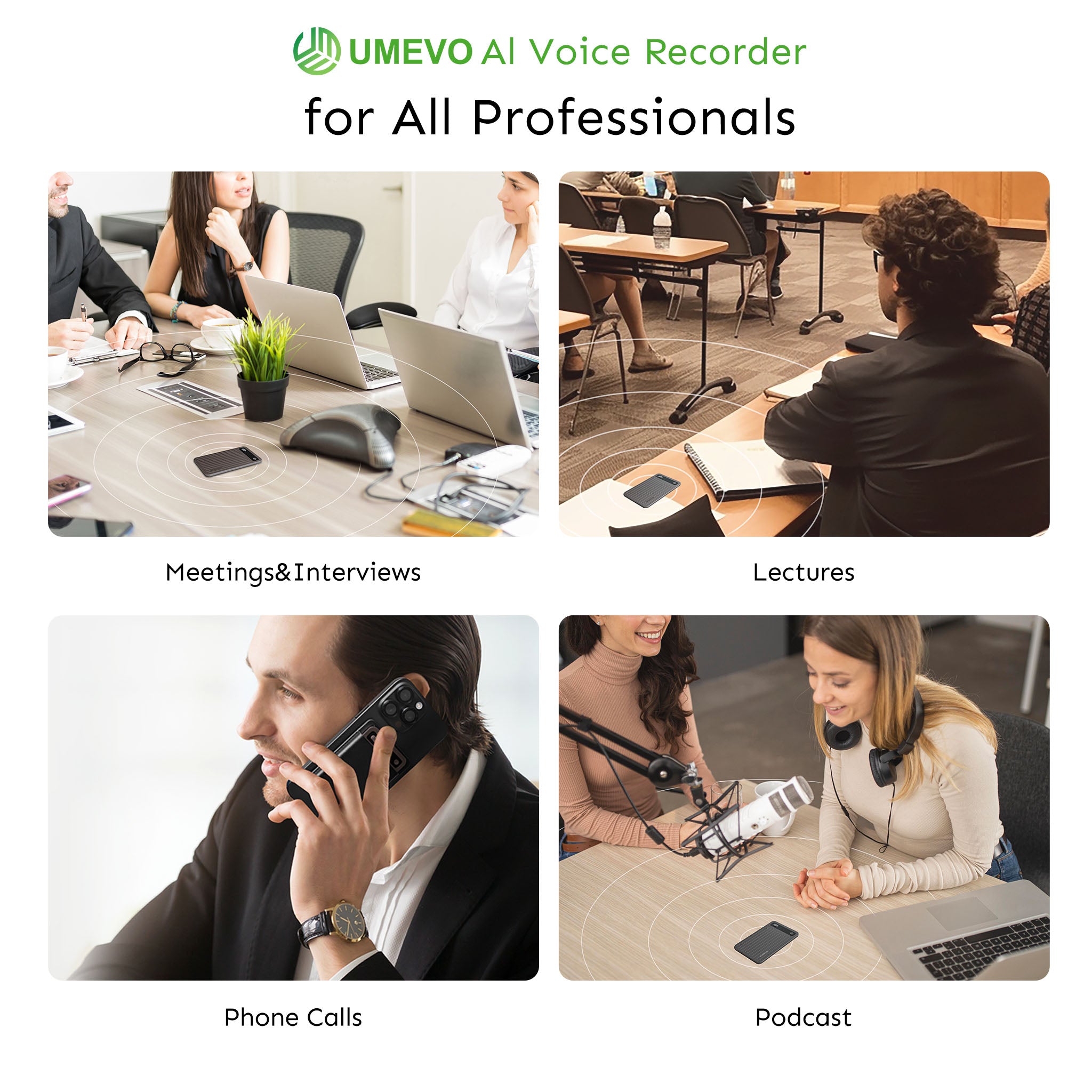
The Plaud Note remains the industry standard for users who prioritize a highly polished, interactive app interface, and is an excellent choice for managers who need visual mind maps. However, for power users who prioritize data sovereignty and zero recurring fees, the UMEVO Note Plus offers a more cost-effective path. With 64GB of storage and a vibration conduction sensor that records calls directly through a smartphone chassis, it eliminates the need for secondary software subscriptions.
It is important to note that the UMEVO Note Plus is not designed for users who want a screenless, quarter-sized wearable; if your primary goal is an invisible form factor, you are better off with the Limitless Pendant. Ultimately, usage volume dictates the purchase. As one expert noted during a field test at the 04:55 mark: "If you're going to conferences at the rate I am, you're probably going to use it for way more than the 5 to 10 hours they offer."
Final Procurement Recommendations
Calculating the AI voice recorder total cost of ownership requires looking past the initial MSRP. Procurement teams must audit the 36-month lifecycle, factoring in the $99 to $239 annual subscription fees, the 25% failure rate that necessitates a $128 Sony UX570 backup recorder, and the physical replacement risks of miniaturized wearables. For enterprise deployments, investing in Hybrid Edge-Processing devices with lifetime starter plans or generous free tiers yields a significantly lower operational TCO than subsidizing endless cloud subscriptions.
Frequently Asked Questions
Do my unused monthly AI transcription minutes roll over?
No. Most major AI voice recorder brands utilize a strict monthly cap. Unused freemium minutes do not roll over to the next billing cycle, meaning users lose any transcription time they do not consume within that specific month.
Can I use an AI voice recorder without a monthly subscription?
Yes. You can bypass subscriptions by purchasing a traditional digital voice recorder (like an EVISTR) and uploading the local MP3 files to free or low-cost third-party transcription software. Additionally, newer 2026 hardware models are beginning to offer lifetime free transcription tiers to compete with subscription-heavy brands.
Why can I not just use an AI recording app on my smartphone?
Using a smartphone app monopolizes the device. If you use an AI app to record a meeting, you cannot use your phone to take notes, scroll, or text. The smartphone microphone will pick up the loud acoustic tapping of your fingers on the glass screen, which severely degrades the audio quality and ruins the AI transcription.
Are cloud-based AI voice recorders HIPAA compliant?
Many budget cloud-based AI recorders are not HIPAA compliant. Sending raw audio to third-party servers introduces severe privacy liabilities. Medical and legal professionals must use Edge-AI devices that process audio locally on the hardware to maintain strict data compliance.
What is the lifespan of an AI voice recorder battery?
Miniaturized wearable recorders (quarter-sized) typically feature a 100-hour battery life but suffer from rapid battery degradation due to daily charging cycles. Credit-card-sized recorders offer up to 45 hours of continuous recording and 60 to 107 days of standby time, resulting in a longer overall hardware lifespan.





0 comments