

Evaluating a no subscription ai note-taker requires calculating the total cost of ownership across hardware procurement, transcription compute allowances, and physical capture versatility rather than accepting initial marketing claims at face value. While pure SaaS meeting bots charge recurring seat taxes of $120 to $360 annually per user, hardware-based alternatives alter this economic model by shifting compute margins to one-time hardware purchases with included transcription tiers. Over a standard three-year operating lifecycle, selecting an AI note-taking architecture with a high baseline minute allowance (such as a 400-minute permanent monthly baseline) and non-expiring pay-as-you-go top-ups reduces total expenditure by 60% to 80% while enabling offline acoustic capture and two-way cellular call recording where software bots cannot operate.
QUICK ANSWER
A true no-subscription AI note-taker eliminates recurring monthly software fees by bundling dedicated local recording hardware with generous cloud speech-to-text allowances. Unlike pure SaaS bots (Otter.ai, Fireflies.ai) that charge $19–$30/seat/month ($684–$1,080 over 3 years), hybrid hardware recorders provide lifetime offline voice capture, permanent monthly transcription quotas (300–400 minutes/month), and non-expiring Pay-As-You-Go (PAYG) top-ups, reducing 3-year Total Cost of Ownership (TCO) to between $149 and $199.
The 3-Year Total Cost of Ownership: SaaS Subscriptions vs. Hardware Recorders
To understand why subscription-free AI voice recorders have gained significant traction among enterprise procurement teams, independent founders, and legal professionals, one must first examine the underlying unit economics of Automated Speech Recognition (ASR)[1].

The Economic Reality of Speech Compute
In modern artificial intelligence infrastructure, the raw compute cost required to transcribe spoken audio into text has become a commoditized utility. According to official OpenAI API developer pricing benchmarks[3], raw speech-to-text inference utilizing the OpenAI Whisper model costs $0.006 per minute ($0.36 per audio hour). Lightweight transcription models (such as gpt-4o-mini-transcribe) reduce this baseline further to $0.003 per minute ($0.18 per audio hour).
When an enterprise or professional subscribes to a dedicated SaaS meeting assistant, they are paying a substantial premium above raw inference costs:
- Otter.ai Business: Costs $19.99 to $20.00 per user/month billed annually ($30.00 per month on monthly billing), generating a 36-month total cost of $684 to $720 (or up to $1,080 on monthly billing).
- Fireflies.ai Business: Costs $19.00 per user/month billed annually ($29.00 per month on monthly billing), resulting in a 36-month total cost of $684 (or up to $1,044).
For teams whose collaboration occurs entirely inside Zoom or Google Meet, SaaS meeting bots remain a functional choice because they integrate directly with enterprise calendars and auto-join scheduled links without manual intervention. However, for individual professionals who process 10 to 20 hours of spoken conversations per month, pure SaaS subscriptions represent a 500%+ markup over raw compute. This compounding expense—often termed "seat-tax creep"—has driven users toward one-time purchase models.
Three-Year Cost Modeling Across Three Categories
- Pure SaaS Subscription Model: At an average of $20/month, the total capital outlay over 36 months reaches $720.00 per seat, with zero salvage value and complete loss of AI transcription capabilities if the subscription lapses.
- Entry-Level Hardware with Paid Upgrade Tiers: Certain hardware recorders enter the market at an upfront price of ~$159.00 but enforce a restrictive 300-minute monthly free Starter quota. Users recording more than five hours per month are forced to purchase an ongoing membership (typically $99.99/year or $11.40/month billed annually). Over 3 years, the total cost reaches $396.00 to $456.00+.
- High-Baseline Hybrid Hardware: Devices engineered with substantial baseline allowances—such as the UMEVO Note Plus[4], which provides an upfront price of $149–$169 including a full 1-year unlimited AI transcription Max Plan, followed by a permanent 400-minute monthly free quota and non-expiring top-ups—maintain a 3-year TCO between $149.00 and $199.00.
For a broader breakdown of hardware architectures currently available on the market, consult our detailed analysis on the best no-subscription AI voice recorders compared in 2026.
Why Pure Cloud Meeting Bots Fail in In-Person and Cellular Environments
While cloud software bots excel at indexing video conference audio streams via direct API integration, their architectural dependency on web conferencing infrastructure introduces three structural limitations.
KEY TAKEAWAY
Cloud meeting bots fail in real-world scenarios because mobile operating systems (iOS and Android) enforce strict audio sandboxing that blocks third-party background applications from recording cellular voice calls. Furthermore, cloud bots require active meeting URLs and persistent internet connections, rendering them inoperative for offline conferences, physical coffee shop negotiations, and spontaneous phone calls.
1. The Social Friction of the "Bot-Chilled Room"
In visual evaluations of corporate sales negotiations and executive coaching sessions, the entry of an automated recording participant (such as OtterPilot, Fireflies.ai, or Clara’s Notetaker) as a visible grid tile creates measurable conversational resistance. Industry observers point out that participants frequently alter their speaking cadence, show reluctance to discuss sensitive commercial terms, or request that the host remove the bot.
Discreet local hardware recording, paired with transparent verbal disclosure, eliminates this software friction while keeping the visual interface focused entirely on human participants.
2. Physical Acoustic Limitations and Room Reverberation
Laptop and smartphone microphones rely on standard condenser capsules designed for near-field pick-up (typically 12 to 24 inches from the screen). In an in-person boardroom, restaurant, or lecture hall:
- Room reverberation degrades acoustic clarity.
- Multi-directional ambient noise obscures subtle vocal inflections.
- Dynamic speaker distance causes wide volume fluctuations, drastically increasing transcription Word Error Rates (WER)[1].
Dedicated hardware recorders overcome these acoustic limitations by pairing specialized omnidirectional microphone arrays with digital signal processing (DSP) noise cancellation algorithms tuned specifically to human vocal frequencies (300 Hz – 3.4 kHz).
3. Mobile Operating System Sandboxing
For mobile professionals, the primary recording challenge is capturing cellular phone calls and encrypted VoIP conversations (e.g., WhatsApp, Signal, WeChat). Both Apple iOS (CoreAudio architecture) and Google Android (AudioRecord API) enforce strict security sandboxing that prevents third-party background applications from intercepting the two-way audio stream of a cellular call.
Software-only recording applications attempt to circumvent this constraint through awkward three-way conference bridging services—a process that is unreliable, requires carrier support, and fails completely on encrypted VoIP apps.
Hardware Architecture: How Dual-Mode Capture Solves Real-World Recording
To record both environmental room conversations and two-way telephone calls without software workarounds, specialized hardware recorders utilize a dual-mode acoustic architecture.

Acoustic Air Microphones vs. Physical Vibration Conduction Sensors (VCS)
- Note Recording Mode (Acoustic Air Microphones): Calibrated dual omnidirectional air microphones capture wide-angle room acoustics. This mode isolates conversational speech across conference tables up to 10–15 feet away while filtering out continuous background hums from HVAC units and projectors.
- Call Recording Mode (Vibration Conduction Sensor): When attached magnetically via MagSafe to the rear casing of a smartphone, a dedicated Vibration Conduction Sensor (VCS) bypasses air acoustics entirely. The sensor captures the physical micro-vibrations generated by the smartphone's internal earpiece transducer alongside the user's vocal resonance conducted through the phone's chassis.
Consequently, the hardware records crystal-clear two-way call audio for cellular calls, WhatsApp, FaceTime, and Zoom Mobile without putting the conversation on loudspeaker or encountering mobile OS API blocks.

Hardware Reliability and Storage Benchmarks
Cloud-dependent smartphone apps carry inherent operational risks: incoming calls can interrupt recordings, background processes can be terminated by aggressive OS battery managers, and weak cellular data connections can prevent audio offloading. Dedicated hardware recorders eliminate these points of failure through purpose-built physical specifications:
- Onboard Flash Storage: Equipped with 64GB of dedicated local storage, a hardware recorder stores approximately 500 hours of uncompressed audio. This enables an attorney or field researcher to complete weeks of off-grid depositions without offloading files to a computer.
- Battery Longevity: Advanced power management architectures deliver 40 hours of continuous active recording and up to 60 days of standby time on a single charge via USB-C.
- Physical Footprint: At just 0.12 inches (3mm) in thickness and weighing 1.06 oz (30g), devices like the UMEVO Note Plus snap cleanly onto MagSafe phone cases without adding noticeable bulk to everyday carry setups.
Minute Economics: Expiration Policies, Top-Ups, and Feature Gating
When evaluating a no-subscription AI voice recorder, the primary operational bottleneck is the monthly minute allotment. Buyers must analyze how different manufacturers manage minute caps, credit expiration, and feature access.
The 300-Minute Trap vs. High Baseline Headroom
Many entry-level AI voice recorders advertise "free AI transcription," but restrict non-paying users to 300 minutes per month.
- Consider a standard professional workflow consisting of two 45-minute team syncs, one 60-minute client briefing, and two 30-minute vendor calls per week.
- This schedule consumes 270 minutes every seven business days.
- Under a 300-minute monthly allowance, the user exhausts their entire free balance before the middle of the second week.
Conversely, a 400-minute permanent monthly baseline delivers 33% more monthly transcription headroom (roughly 6.7 hours). For moderate users, this difference bridges the gap between a tool that functions reliably and one that constantly demands credit top-ups.
For an extensive audit of free allowances and limits across both software and hardware ecosystems, review our guide to free AI note-takers and where each one caps out.
EXPERT DECISION NOTE
Monthly subscription minutes operate on a "use-it-or-lose-it" basis—if you only use 60 of your 300 minutes in July, the remaining 240 minutes vanish at billing reset. When evaluating hardware, verify that top-up credits are sold as Pay-As-You-Go (PAYG) non-expiring balance packs. This ensures that unused purchased minutes remain in your account indefinitely.

Intelligence Stack and Data Portability
A no-subscription model must not compromise on natural language processing capabilities. Current flagship hybrid hardware devices integrate advanced Large Language Models (LLMs) such as ChatGPT-4o to deliver:
- Multi-Language Transcription: Support for over 140+ languages and dialects, including real-time cross-language translation.
- Structured Information Synthesis: Automated generation of visual mind maps, executive summaries, chronological meeting minutes, and custom prompt-engineered output templates.
- Speaker Identification & Diarization: Algorithmic separation of individual speaker turns, assigning specific action items to identified participants.
-
Unrestricted Data Portability: Complete export flexibility supporting raw lossless audio (WAV/MP3), plain Markdown (
.md), PDF, and plain text without forcing users into proprietary cloud silos or subjecting transcripts to 90-day archive locks.
Workflow Integration, Speaker Analytics, and Legal Compliance
Transitioning from raw meeting audio to finished documentation requires efficient post-processing software, granular analytics, and strict adherence to recording legislation.
Best FREE AI Note Taker of 2026 (Radiant App Review) | 100% Free Botless Note Taker

Post-Meeting Execution Speed and Analytics
In workflow integration tests, modern hybrid note-takers streamline post-call follow-ups. Rather than manually copying transcripts into third-party text editors, direct integrations enable one-click execution:
- Instant Email Routing: Demonstrations show workflows where clicking a direct "Continue in Gmail" action button automatically populates a formatted draft with key decisions, unresolved blockers, and categorized action items assigned by name.
- Conversational Transcript Interrogation: Users can query archived meetings via natural language chat prompts (e.g., "How long did the engineering team spend discussing database latency?"). The underlying AI analyzes speaker timestamps to calculate exact elapsed durations across the agenda.
- Granular Participation Metrics: Advanced diarization engines produce visual breakdown dashboards displaying total word count per participant, speaking percentage distributions (e.g., Speaker 1: 58% / Speaker 2: 42%), and conversational interruption patterns.
To optimize your post-meeting documentation pipeline, read our step-by-step workflow guide on how to turn meeting recordings into action items.
Technical Edge Cases and Legal Safeguards
CRITICAL COMPLIANCE WARNING
Discreet hardware recording does NOT exempt users from recording consent laws. In the United States, 11 to 12 states—including California (Cal. Penal Code § 632), Florida (Fla. Stat. § 934.03), and Massachusetts (Mass. Gen. Laws ch. 272 § 99)—are "two-party" or "all-party" consent jurisdictions. You must clearly state to all participants that the conversation is being recorded before engaging the device.
- The "Short-Meeting" Processing Threshold: Users should note that LLM summarization algorithms enforce minimum audio length constraints. In testing, audio clips shorter than 60 seconds frequently trigger processing errors ("Looks like your meeting was too short to generate a summary"). For brief 30-second memos, rely on direct raw transcription rather than multi-section summary templates.
- Data Sovereignty: Enterprise procurement teams must verify that hardware vendors do not utilize customer voice recordings to train proprietary foundation models without explicit organizational consent.
Decision Matrix: Selecting the Right No-Subscription AI Note-Taker
The following structured decision aid compares the three primary market categories: cloud-based meeting bots, entry-tier hardware with paid membership gates, and true high-baseline hybrid hardware.
| Feature / Metric | Pure Cloud SaaS (Otter / Fireflies) | Entry Hardware (Plaud Note) | High-Value Hybrid (UMEVO Note Plus) |
|---|---|---|---|
| Upfront Hardware Price | $0.00 | ~$159.00 | ~$149.00–$169.00 |
| Year 1 Transcription Plan | $120.00–$240.00 | 300 min/mo Starter | 1 Year Unlimited Max |
| Ongoing Year 2+ Fees | $120.00–$240.00 / yr | Free 300m or $99/yr | Perm. 400m/mo Free+PAYG |
| 3-Year Real TCO (Heavy) | $684.00–$1,080.00 | $396.00–$456.00+ | $149.00–$199.00 Total |
| In-Person Acoustic Capture | Laptop Mic Only | Dual Air Microphones | Dual Air Mics (40h Bat) |
| Phone Call Recording | Not Supported (VoIP) | MagSafe VCS Sensor | MagSafe VCS Sensor |
| Onboard Offline Storage | None (Cloud Only) | 64GB Flash Memory | 64GB Flash Memory |
| Platform Compatibility | Web / Desktop Apps | iOS / Android Only | iOS / Android / PC / Mac |
Concrete Scenario Decision Rules
- Scenario A (100% Virtual Enterprise Teams): If your daily schedule consists exclusively of remote Zoom/Google Meet calls, you never record in-person meetings, and you require calendar auto-join bots that operate without touching a physical device, choose Fireflies.ai or Otter.ai.
- Scenario B (Established Single-Ecosystem Users): If you already own compatible accessories within a specific hardware maker's ecosystem and your recording volume is strictly under 5 hours per month, choose Plaud Note.
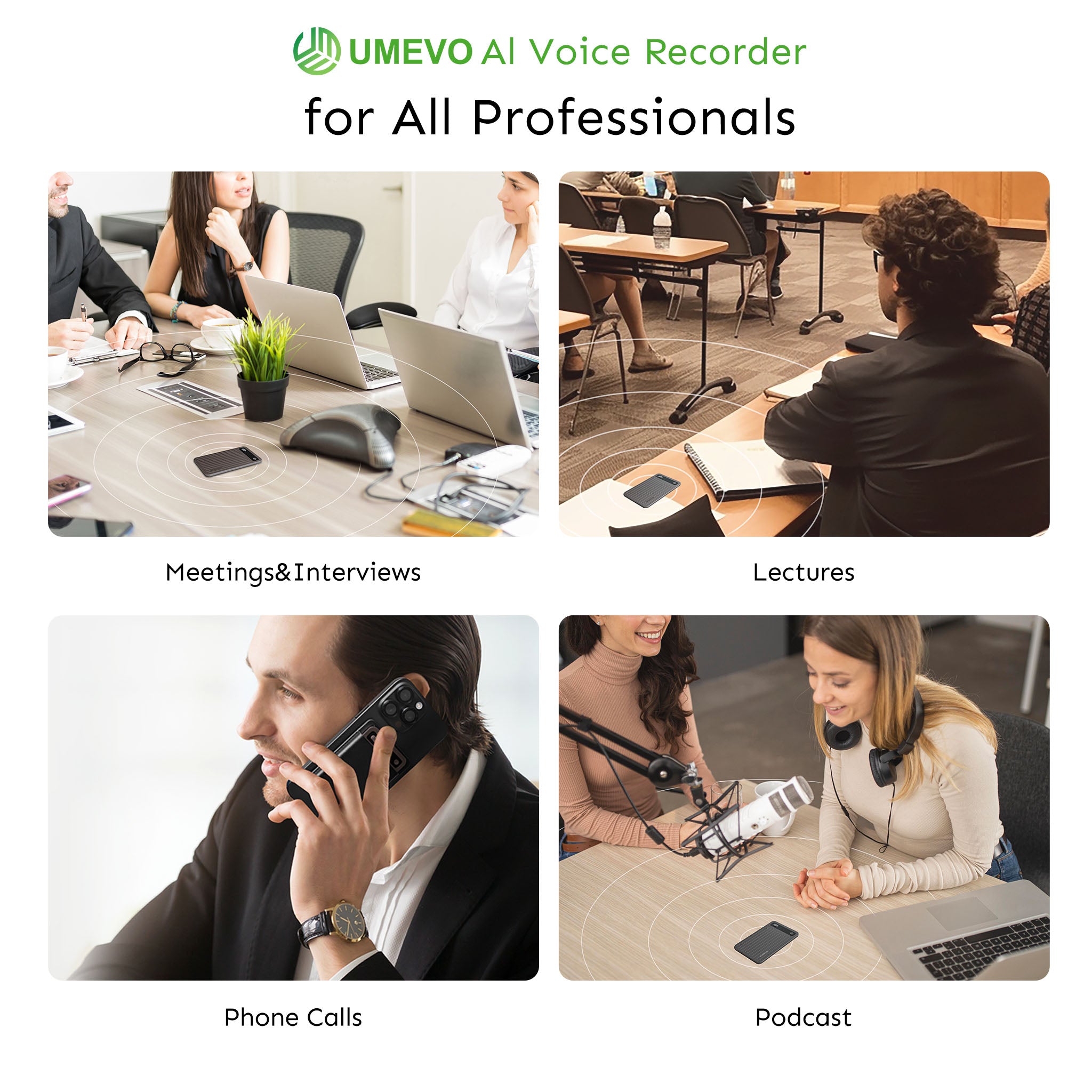
- Scenario C (Cost-Conscious Mobile Professionals & Founders): If you conduct a mix of face-to-face negotiations, cellular/WhatsApp phone calls, and virtual conferences, and you want to minimize your 3-year TCO while securing generous baseline allowances, a high-baseline hybrid hardware option such as the UMEVO Note Plus Magnetic Voice Recorder[4] fits this profile well.
What the Community and Real-World Testers Report
Analysis of user discussions across technology forums, procurement communities, and independent benchmarking groups highlights several consistent observations regarding subscription-free AI hardware:
- Relief from Subscription Fatigue: Users consistently report frustration with traditional SaaS seat licensing, noting that paying recurring monthly fees for occasional meeting transcription represents poor capital allocation.
- MagSafe Ergonomics and Dual-Mode Utility: Enthusiasts frequently highlight the utility of physical MagSafe attachment for phone call recording. Field testers note that switching to vibration conduction provides clean audio capture on cellular calls where software apps produce one-sided silence.
- Local Storage as a Safety Net: Real-world testing emphasizes the value of 64GB onboard memory. Users who record in basement conference facilities or during international flights report that local flash storage eliminates the anxiety of lost data caused by dropped Wi-Fi connections.
- Who Dedicated Hardware is NOT For: Community feedback also confirms that dedicated physical recorders are unnecessary for individuals who only need occasional text dictation or who prefer software plugins integrated directly into their web browser.
Strategic Summary and Frequently Asked Questions
Understanding the real long-term cost of an AI note-taker requires looking beyond upfront retail pricing. Software subscriptions mark up underlying commodity ASR compute by over 500% according to standard API pricing benchmarks[3], compounding into hundreds of dollars in recurring seat taxes over multi-year periods.
By investing in high-baseline hybrid hardware equipped with dual-mode vibration sensors and permanent monthly minute allotments, professionals secure reliable two-way call recording, offline resilience, and enterprise-grade LLM intelligence while permanently reducing their three-year operating costs.
Frequently Asked Questions
1. What happens to a no-subscription AI voice recorder if I exceed the free monthly minutes?
If you exceed your free monthly transcription quota, your physical hardware recorder continues to function normally as an offline digital voice recorder, capturing uncompressed audio to its onboard 64GB flash memory. To process additional transcripts via AI, you can purchase non-expiring Pay-As-You-Go (PAYG) credit packs on demand without committing to a recurring monthly subscription.
2. Can a hardware AI note-taker record phone calls without turning on the loudspeaker?
Yes. Dedicated hardware recorders equipped with a Vibration Conduction Sensor (VCS) adhere magnetically to the back of your smartphone via MagSafe. The sensor captures the mechanical acoustic vibrations generated directly by the phone's internal earpiece transducer and chassis, recording both sides of cellular, WhatsApp, and FaceTime calls clearly without activating the speakerphone.
3. Why are SaaS meeting bots more expensive over time than dedicated AI hardware?
Raw speech recognition compute via foundation models (like OpenAI Whisper[2]) costs approximately $0.003 to $0.006 per minute ($0.18 to $0.36 per hour) based on official API pricing[3]. Pure SaaS platforms mark up these processing costs to cover their recurring server overhead, charging $19 to $30 per user/month. Over 36 months, this seat tax totals $684 to $1,080 per seat, whereas dedicated hybrid hardware costs between $149 and $199 total over the same timeframe.
4. How accurate is AI transcription without a recurring cloud subscription?
Transcription accuracy is determined by the underlying speech model and audio capture quality rather than the subscription tier. Flagship hybrid hardware sends captured audio to cloud LLMs (such as ChatGPT-4o and Whisper-based pipelines), achieving Word Error Rates (WER) comparable to or exceeding expensive SaaS platforms according to industry standard benchmark methodologies[1], provided the acoustic recording is clear.
5. Do I need to disclose that I am recording if the AI note-taker does not join as a visible bot?
Yes. Using a discreet hardware recorder does not exempt you from wiretapping and recording consent laws. In "two-party" or "all-party" consent jurisdictions (such as California under Cal. Penal Code § 632, Florida under Fla. Stat. § 934.03, and Massachusetts under Mass. Gen. Laws ch. 272 § 99), you are legally mandated to inform all conversation participants and obtain their explicit verbal consent before capturing audio.
References
- 1998 Broadcast News Benchmark Test Results: English and Non-English Word Error Rate Performance Measures — National Institute of Standards and Technology
- Robust Speech Recognition via Large-Scale Weak Supervision — OpenAI
- Pricing | OpenAI API — OpenAI
- UMEVO Note Plus Magnetic AI Voice Recorder — UMEVO





0 comments