

Sales representatives spend only 28% to 30% of their working hours actively selling. The remaining 70% disappears into manual CRM updates, fragmented meeting notes, and administrative tasks that generate no revenue. According to the Salesforce State of Sales report, this translates to 10 to 13 hours per week lost per rep—time that could otherwise be spent qualifying prospects or advancing deals.
This guide examines how dedicated AI voice recording hardware solves this problem differently than software meeting bots. Hardware recorders capture audio through physical sensors rather than app permissions, bypassing iOS restrictions while eliminating the recurring subscription costs that inflate total cost of ownership. The result is structured, CRM-ready sales intelligence from every conversation—whether it happens on a cellular call, a video conference, or across a conference room table.
We cover the operational cost of manual note-taking, the technical and psychological limitations of software bots, the audio engineering behind hardware capture, prompt frameworks that turn raw transcripts into deal summaries, legal compliance across jurisdictions, and a comparative evaluation of hardware solutions.
The 13-Hour Admin Drain: Why Traditional Sales Note-Taking Fails
Sales organizations lose more deals to administrative decay than to competitive losses. The root cause is structural: manual note-taking creates a chain of inefficiencies that compounds across the sales pipeline.
The Hidden Cost of CRM Data Decay
When sales reps type notes from memory hours after a call ends, two failures occur. First, the rep forgets specific phrasing, objections, and commitments that surfaced during the conversation. Second, the rep spends time reconstructing a partial record instead of engaging the next prospect.
Research benchmarks show that unintegrated meeting notes leave up to 91% of CRM records incomplete or outdated. For a team of ten reps, this means nearly every deal record in the pipeline lacks the full context needed for accurate forecasting or effective SDR-to-AE handoff. Sales managers review pipelines built on partial data, and executive decisions rest on incomplete intelligence.

How Active Note-Taking Disrupts Prospect Rapport
Writing notes during a live discovery call forces the rep to split cognitive bandwidth between recording and listening. When a prospect hesitates before answering a budget question, that pause carries information—but a rep typing the previous answer misses the signal entirely.
The damage extends beyond missed cues. Prospects who watch a rep type throughout a conversation perceive divided attention. Trust-building requires full presence; divided attention signals that the rep prioritizes internal process over the prospect's situation. For account managers handling expansion conversations, this dynamic subtly erodes the relationship value that justifies premium pricing.
From Raw Audio to Actionable Sales Intelligence
Raw call transcripts solve the documentation problem but create an information retrieval problem. A 45-minute discovery call produces roughly 7,000 words of dialogue. Sales managers reviewing five calls per rep cannot read 35,000 words of transcripts before pipeline meetings. Most do not try.
The output format determines whether sales intelligence gets used or ignored. Transcripts converted into structured summaries—organized by deal stage criteria, extracted objections, and bifurcated action items for buyer and seller—turn audio archives into decision-ready inputs. This shift from transcription to structured intelligence is where AI processing adds measurable pipeline velocity.
Software Meeting Bots vs. Hardware Recorders: Overcoming Bot Fatigue and iOS 18 Restrictions
Software meeting bots transformed virtual selling during the remote work shift. They also introduced friction points that become acute in high-stakes sales conversations and mobile selling scenarios.
The Psychological Chilling Effect of Visible Meeting Bots
When a prospect joins a Zoom call and sees "Otter Notetaker," "Fireflies.ai Notetaker," and "Fathom Notetaker" listed as participants alongside the seller, something shifts in the conversation dynamic. Community forums and real-world testing confirm what sales psychologists have long observed: visible algorithmic monitoring triggers self-censorship.
Prospects become more guarded when they know every word is being captured, transcribed, and analyzed by an unknown AI platform. For executive-level conversations involving strategic priorities, budget constraints, or vendor dissatisfaction, this chilling effect suppresses the candid information that distinguishes qualified deals from surface-level interest.
In visual stress tests comparing multiple AI tools, evaluators intentionally inserted off-topic banter—trips, casual anecdotes, even a detailed discussion about toilet-training a cat—to test whether AI engines filter noise or pollute deal records with irrelevant data. The most effective tools ignored the cat training entirely and surfaced only the substantive deal content. Less sophisticated engines captured everything verbatim, forcing reps to manually clean junk data from CRM entries.
I tested 22 AI notetakers: Which one captures the best sales meeting notes?
For field sales representatives and account managers who conduct client lunches, site visits, and in-person meetings, the bot question is moot. No software meeting bot can join a conversation that does not occur on a video platform. The technology simply does not apply.
Navigating iOS 18 Audio Restrictions
Starting in iOS 18.1, Apple enforces a mandatory audio announcement when software call recording is active: "This call will be recorded." The alert plays to both participants and cannot be disabled or bypassed through software configuration. Third-party call recording APIs face the same restriction at the operating system level.
For a sales rep connecting with a C-level prospect over a mobile call, this automated warning introduces a compliance friction that disrupts conversational flow. The prospect hears a robotic disclaimer and immediately recalibrates their openness. The seller must then explain and re-establish comfort—assuming the prospect does not simply end the call.
How Vibration Conduction Sensors Capture Clear Chassis Audio
Hardware recorders solve the iOS 18 problem through physics rather than software. Piezoelectric vibration conduction sensors detect sound waves traveling through the phone chassis itself. When a rep attaches a MagSafe-compatible recording device to their phone and switches to Call Recording mode, the sensor captures the physical vibrations that the phone's speaker and internal components generate during a conversation.
This method operates independently of the phone's operating system, app permissions, and software call-recording APIs. The capture occurs at the hardware layer, immune to OS-level restrictions and audio announcements. The same mechanism works for cellular calls, WhatsApp conversations, Zoom mobile sessions, and any other audio the phone produces—because the sensor registers mechanical vibration rather than intercepting a software signal.

Turning Raw Audio into Closed Deals: Structuring AI Sales Summaries
Capturing audio solves the recording problem. Structuring that audio into deal-moving intelligence solves the revenue problem. The difference lies in how AI summary engines format their output.
Avoiding the Wall of Text Trap
Comparative analysis of AI note-taking tools reveals a clear divide. Engines that default to dense, multi-sentence paragraph summaries produce output that sales managers and reps consistently ignore. Tools like Otter.ai and Read.ai generate overview sections that read like transcribed monologues—comprehensive but unscannable.
By contrast, tools that render clean Markdown layouts with clear headers and indented bullet points enable rapid review. When a summary displays the deal situation, key stakeholders, pain points, and next steps in visually segmented sections, a sales manager can absorb the full context in 15 seconds rather than five minutes.
The output format is not an aesthetic preference. It determines whether pipeline intelligence gets used at all.
Automated Objection Extraction and Sales Framework Tagging
AI models powered by ChatGPT and similar engines process raw audio into structured sales intelligence when guided by the right prompt architecture. The machine listens for specific linguistic patterns: hesitation markers before budget discussions, competitive vendor mentions, timeline urgency indicators, and stakeholder role references.

These signals map directly onto standard qualification frameworks. MEDDIC criteria—Metrics, Economic Buyer, Decision Criteria, Decision Process, Identify Pain, Champion—emerge from the transcript as tagged fields rather than buried text. BANT elements surface in the same pass. Objections appear as isolated, labeled entries with the exact phrasing the prospect used, not an interpreted paraphrase from the rep's memory.
Experts point out that the best AI sales tools automatically detect key deal roles—VP of Sales, CFO, Director of RevOps—without requiring pre-selected call category templates. The engine recognizes role language organically and structures the summary accordingly, reducing the setup friction that causes adoption gaps across sales orgs.
Separating Buyer Commitments from Rep Action Items
One of the most common failures in sales follow-up is action item misattribution. The rep commits to sending a security questionnaire; the prospect commits to introducing the economic buyer. Both obligations appear in the notes, but the distinction between them blurs over the days following the call.
Effective AI summary engines bifurcate these commitments explicitly. The output contains a section for rep responsibilities and a separate, clearly labeled section for prospect commitments. In visual benchmarks, tools like Circleback, Krisp, and Fireflies.ai produced this separation automatically, assigning specific tasks to named individuals on both sides of the deal.
This separation matters for pipeline velocity. When a rep can forward a summary showing exactly what the prospect committed to deliver and by when, follow-up emails shift from "checking in" to "confirming receipt of the materials you offered to send." The dynamic changes from pursuit to partnership.
Comparing Hardware AI Voice Recorders: Features, Specifications, and Total Cost of Ownership
Selecting an AI voice recording solution requires evaluating three dimensions: hardware capability, AI processing quality, and total cost of ownership over the expected deployment period.
Hardware Specifications That Matter for Sales Environments
Sales conversations occur across diverse acoustic environments. A rep might take a cellular call from a car, conduct a client lunch in a restaurant with ambient noise at 70dB, or sit in a conference room with poor acoustics. Hardware must perform reliably across all these conditions.
Key specifications for sales use include battery endurance sufficient for a full week of field work without recharging, local storage capacity that eliminates anxiety about running out of space during critical conversations, and physical controls that allow mode switching without looking at a screen or navigating menus.
Weight and profile matter for mobile sales professionals who carry devices in pockets or attach them to phones. A device that adds noticeable bulk becomes one more item left behind at the office, defeating the purpose of mobile capture.
Hardware Comparison and Cost Decision Matrix
The table below maps key evaluation criteria across three categories of recording solutions.
| Feature | Software Meeting Bots | Generic Digital Recorders | Specialized AI Hardware |
|---|---|---|---|
| Call Compatibility | Zoom, Teams, Google Meet only | In-person only (microphone capture) | Cellular calls, VoIP, Zoom, Teams, In-Person |
| Mobile Integration | Fails on cellular and native calls | Manual file transfer required | MagSafe snap-on magnetic attachment |
| Audio Capture Technology | Software API / Bot participant | Standard condenser microphone | Dual Microphone + Vibration Conduction Sensor |
| OS Restriction Immunity | Subject to iOS 18+ warnings and API blocks | N/A (external hardware) | Fully immune (physical chassis capture) |
| AI Processing | SaaS cloud with monthly fee | None (manual transcription required) | ChatGPT/Gemini AI (140+ languages) |
| Summary Structure | Generic bullet points, often dense paragraphs | None | Custom sales templates (MEDDIC, BANT, Objections) |
| 3-Year TCO | $540–$1,080 per user ($15–$30/month) | $50–$150 (hardware only, no AI) | $149–$169 upfront with flexible pay-as-you-go AI |
Field Versatility and Battery Performance
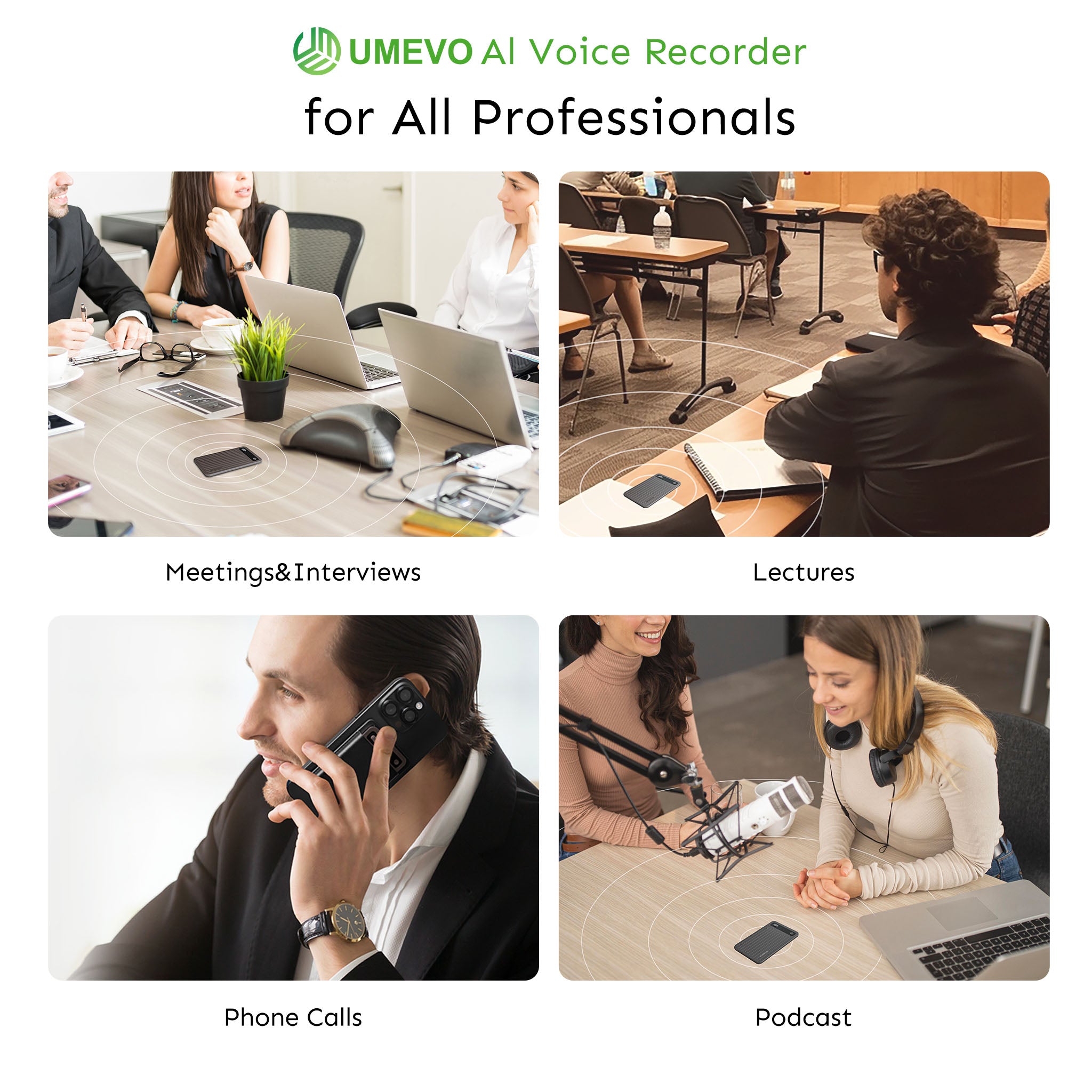
Specialized AI hardware designed for sales environments combines dual-mode recording with extended battery endurance. In Call Mode, the vibration conduction sensor captures phone conversations at the chassis level. In Note Mode, omnidirectional microphones record in-person meetings with equal fidelity.
The UMEVO Note Plus magnetic call recorder[1] exemplifies this approach with specifications tuned for field sales: 40 hours of continuous recording eliminates mid-week charging anxiety, while 60 days of standby ensures the device powers on instantly when an unexpected client call occurs. The 64GB of built-in storage accommodates approximately 400 hours of uncompressed audio—roughly three months of heavy meeting volume without file management. At 0.12 inches thick and 1.06 ounces, the device attaches to a phone via MagSafe without adding pocket bulk.
The dual-mode physical switch enables toggling between Call Recording and Note Recording with a single press, removing the software navigation that interrupts workflow during fast-paced selling days.

For professionals who also capture study notes, academic lectures, or research interviews, similar hardware principles apply. The Best Smart Voice Recorder for Study Notes Guide covers additional use cases beyond the sales context.
Software Subscriptions vs. Pay-As-You-Go: Calculating 3-Year Total Cost of Ownership
The pricing model difference between SaaS meeting bots and hardware recorders creates a substantial TCO gap that compounds with team size.
Standard SaaS meeting bots charge $15 to $30 per user per month. Over three years, a single rep using a $20/month bot costs the organization $720. A team of ten reps generates $7,200 in subscription costs over the same period, and the expense continues indefinitely as long as the team needs transcription.
Hardware recorders shift this cost structure from recurring operating expense to one-time capital expenditure. The device cost of $149 to $169 represents the primary hardware investment. The first year of AI transcription is included at no additional charge through the Max Plan. After year one, users receive 400 free transcription minutes monthly, with flexible top-ups as low as $0.59 for 120 additional minutes.
This pay-as-you-go model eliminates the mandatory monthly subscription that locks teams into recurring costs regardless of usage volume. For a rep recording 10 hours of calls per month, the cost per recorded hour under a SaaS model runs $1.50 to $3.00. Under the hardware pay-as-you-go model, that same volume costs effectively nothing within the free tier, with marginal top-up costs only when exceeding the included minutes.

Legal Compliance and Security: One-Party vs. Two-Party Consent and GDPR
Recording sales conversations carries legal obligations that vary by jurisdiction. Sales teams operating across state or national boundaries must understand which rules apply to each call they conduct.
Navigating U.S. Wiretap Laws
United States call recording law divides into two frameworks. Federal law and 37 to 38 states follow one-party consent: one participant in the conversation can legally record without informing others. However, 13 to 15 states, including California and Florida, require all-party consent—every participant must be aware of and agree to the recording.
The critical legal precedent for interstate calls comes from Kearney v. Salomon Smith Barney, Inc. (California Supreme Court, 2006). The court ruled that when a call connects a participant in a one-party consent state with a participant in an all-party consent state, the stricter all-party consent law governs the entire conversation.
For sales teams, this means defaulting to disclosure whenever calling into or out of any two-party consent jurisdiction. The practical solution is simple: brief, conversational consent at the start of every recorded call.
GDPR Data Processing and Encryption Standards
Under GDPR, voice recordings qualify as personal data—and potentially biometric data when used for speaker identification. The regulation imposes specific obligations: explicit consent or documented legitimate interest as the legal basis for processing, clear purpose limitation (the recording exists for the stated purpose and nothing else), data encryption at SOC 2 and HIPAA-comparable standards, and defined retention policies with deletion timelines.
European sales teams must integrate these requirements into their recording workflow from the start. Retroactive compliance is not possible once calls have been collected without proper consent architecture.
For detailed guidance on European compliance frameworks, see the GDPR and AI Voice Recorders: What European Teams Must Know Before Recording guide.
Similar compliance standards apply in other regulated fields. Therapeutic and clinical practitioners face parallel requirements for session documentation; the AI Voice Recorders for Therapists Compliance Guide covers those specific frameworks.
Practical Disclaimer Scripts
The key to ethical recording is making consent feel natural rather than legalistic. A stiff, lawyer-written disclaimer signals risk and triggers prospect resistance. A conversational opener preserves trust while meeting all-party consent requirements.
Effective scripts for sales calls:
- "I find that taking notes during calls means I miss half of what you're saying. Do you mind if I use an AI note-taker to capture everything accurately? I'll share the summary with you afterward."
- "Quick heads up—I use a tool that helps me track all your requirements so I don't misremember anything. That work for you?"
- "I want to make sure I catch every detail of what you need here. I'm recording on my end—is that okay?"
The common pattern: frame consent as a benefit to the prospect (accurate requirement capture, shared notes afterward) rather than a legal box to check. Most prospects say yes without hesitation.
Summary
Sales teams lose 70% of their working week to non-selling activities, with manual CRM data entry consuming 10 to 13 hours per rep. Software meeting bots partially address this but introduce their own friction: visible bot participants trigger prospect self-censorship, iOS 18 restrictions force audio announcements that disrupt mobile call rapport, and SaaS subscription costs compound across team size into significant three-year commitments.
Hardware AI voice recorders using vibration conduction sensors operate outside these constraints. Physical audio capture at the chassis level bypasses OS restrictions. Dedicated hardware records cellular calls, WhatsApp conversations, and in-person meetings where software bots cannot participate. Pay-as-you-go AI transcription models eliminate mandatory monthly subscriptions, delivering 3-year TCO advantages that scale with team size.
The output that matters is not the recording itself, but the structured sales intelligence extracted from it: objections tagged to qualification frameworks, buyer commitments separated from rep action items, and CRM-ready summaries formatted for scanning rather than reading.
For sales teams, account managers, and founders looking to upgrade pipeline intelligence, the UMEVO Note Plus Magnetic AI Voice Recorder[1] provides the hardware capture and AI processing capability covered throughout this guide, with 1 year of free unlimited AI transcription and subscription-free pay-as-you-go flexibility after that initial period.
Frequently Asked Questions
How does an AI voice recorder capture phone calls without adding a meeting bot?
Devices using Piezoelectric Vibration Conduction Sensors attach to the phone magnetically. When set to Call Recording mode, the sensor directly converts physical sound vibrations from the phone's internal chassis into clear audio, capturing both sides of the conversation without relying on software permissions, API access, or bot participants joining the call.
Is it legal to record sales calls using a hardware voice recorder?
Yes, provided you follow applicable wiretap regulations. In the U.S., 37 to 38 states follow one-party consent, but 13 to 15 states require all-party consent. For interstate calls, the stricter jurisdiction's law applies per Kearney v. Salomon Smith Barney. The practical solution is a brief verbal disclosure at the start of every recorded call. Under GDPR, voice recordings qualify as personal data requiring explicit consent or legitimate interest, purpose limitation, and encrypted processing standards.
How do AI summaries integrate into CRMs like Salesforce or HubSpot?
AI transcription platforms process recorded audio through language models and output structured summaries in clean Markdown format. Reps can copy-paste segmented sections—MEDDIC qualification fields, client objections, buyer action items—directly into CRM deal records, or automate the transfer through webhook integrations.
Will hardware call recorders work during in-person field meetings?
Yes. Hardware recorders feature dual-mode operation. In Call Mode, vibration conduction sensors capture phone conversations. In Note Mode, omnidirectional microphones record in-person meetings, client lunches, and site visits with the same device. Battery life of 40 continuous hours supports full field deployment without recharging.
What happens after the first year of free AI transcription?
UMEVO Note Plus includes 1 year of free unlimited AI transcription through the Max Plan. After year one, users continue receiving 400 free transcription minutes every month. Additional minutes are available through flexible top-ups at $0.59 per 120 minutes, with no mandatory monthly subscription required at any point.





0 comments