

User interviews contain your most valuable product intelligence, but most of that insight never reaches a roadmap decision. The "Insight Graveyard"—a structural failure documented in 2026 product management analysis—describes the common scenario where hours of customer conversations are recorded, transcribed, and archived without ever influencing feature prioritization. Product managers don't lack user data; they lack the infrastructure to synthesize raw audio into structured, actionable inputs. Modern product teams are closing this gap with an AI voice recorder for product managers—dedicated hardware that bypasses software recording restrictions, eliminates manual transcription, and generates roadmap-ready summaries directly from conversations.
This guide examines why software-only transcription fails product teams, the hardware physics that enables reliable call recording, the legal framework for ethical data collection, a repeatable synthesis workflow, and the true cost comparison between subscription models and one-time hardware investments.
Why User Research Gets Stuck Before the Roadmap
The gap between collecting user feedback and acting on it is not a motivation problem. It is an infrastructure problem. A single round of 10 user interviews generates approximately 7-10 hours of audio. Manual transcription consumes roughly four hours of work for every one hour of recording. For a product manager running biweekly research cycles, the math becomes unsustainable within the first month.
Consequently, raw audio files sit in shared drives. Notes remain half-complete. The engineering team requests user validation for a sprint decision, but the evidence exists only as an unsearchable recording nobody has time to revisit. This is the Insight Graveyard in practice.
Why Software Bots Undermine Interview Dynamics
Many teams deploy meeting bots that join video calls as silent participants to capture transcripts. The problem is behavioral, not technical. When users see a third-party bot in the call, they self-edit. A candid conversation about workflow frustrations becomes a measured, professional exchange that strips out the emotional signals product teams need to assess urgency and severity.
Furthermore, software bots depend on platform integrations. An iOS update, a change to Google Meet permissions, or a corporate VPN configuration can silently disable recording without warning. Discovering the failure after a critical interview is a risk most PMs accept without realizing alternatives exist.
When AI Misinterprets Technical Jargon
The final failure point is transcription accuracy. General-purpose AI models perform reasonably on conversational English but degrade sharply when encountering product-specific vocabulary. In 2026 benchmarks, terms like "API" appeared as "happy," "SaaS" as "sass," and "on-prem" as "on prem ice." These errors compound in speaker diarization, where the model must also distinguish between the interviewer's questions and the user's answers.
While many guides suggest adding custom glossaries to transcription software, professional workflows actually require high-fidelity audio capture at the source. Physical microphones with wider frequency response and better noise rejection produce cleaner waveforms for AI processing, reducing the error rate on jargon by capturing consonant sounds that software-based recording often muddies.
Why an AI Voice Recorder for Product Managers Outperforms Software Bots
The fundamental difference between hardware recorders and phone apps is physical access to sound. Software applications must request permission from the operating system to access the microphone. On modern iOS and Android devices, call recording through software is either blocked entirely or flagged to all participants, because the OS treats the call audio stream as protected.
Hardware recorders operate independently of the phone's operating system. They capture sound waves directly from the air, or—in the case of call recording—from physical vibrations traveling through the device chassis.
The Science of Vibration Conduction
When you hold a phone to your ear during a call, the earpiece speaker produces sound by vibrating a small membrane. Those vibrations transfer into the phone's housing and travel through the glass and metal as mechanical energy. In 2025, Penn State University researchers demonstrated that these chassis vibrations carry enough acoustic information to reconstruct speech with high accuracy when processed through AI speech recognition models.

This principle enables hardware recorders with vibration conduction sensors to capture both sides of a phone conversation without accessing the phone's software audio stream. The sensor physically attaches to the phone (often via MagSafe on iPhones) and translates mechanical vibrations into an audio file. No app permissions, no OS restrictions, no silent bot joining the call.
For professionals who need to record in-person conversations, the same device switches to its air-conduction microphone array. This dual-mode capability means one device covers phone interviews, conference room discussions, and solo research debriefs.
Audio Fidelity and AI Accuracy
A counter-intuitive fact emerges from testing: the audio quality that matters for AI transcription is not the same quality that matters for human listening. In visual stress tests, reviewers observed that even audio which sounds slightly muffled or distant to a human ear gets processed accurately by modern AI models. What degrades AI performance is not volume but signal-to-noise ratio—background hum, echo, and overlapping frequencies.
Dedicated hardware microphones typically achieve better signal-to-noise ratios than phone microphones because they use larger condenser elements and directional pickup patterns. The result is a cleaner waveform that preserves the consonant sounds AI models need to distinguish between similar-sounding technical terms.
Discreet Recording and Real-Time Bookmarking
Professional hardware recorders include interface decisions designed for meeting environments. During recording, the device displays a waveform for a few seconds, then collapses it into a small indicator dot. This prevents the recorder from becoming a visual distraction on a conference table.
More importantly, a physical button on the device enables real-time bookmarking. During an interview, when a user says something that should become a roadmap item—a specific pain point, a feature request, a competitive comparison—pressing the button once drops a timestamped marker. The companion AI then prioritizes those bookmarked segments during summary generation, saving the PM from scrubbing through the full recording to relocate key moments.

Legal and Ethical Recording Practices
The legal landscape for recording conversations varies by jurisdiction, and product managers conducting cross-border research face particular complexity. United States federal law and UK regulations follow one-party consent rules, meaning only one participant in the conversation needs to be aware of the recording. Countries including Germany, France, and several US states require all-party consent.
When recording calls between jurisdictions, there is no single international standard. According to 2026 legal analyses, professionals are advised to default to the stricter all-party consent rule to avoid severe penalties, particularly under GDPR enforcement in European jurisdictions.
The Trust-First Approach
Regardless of legal minimums, the professional standard for product managers is to always request explicit consent before recording. This serves three purposes: it satisfies the strictest applicable law, it builds trust with the interview subject, and it signals professionalism. Users who know they are being recorded and understand how their data will be used tend to provide more thoughtful, detailed answers.
A practical script: "I'd like to record our conversation so I can focus on listening rather than typing notes. The recording will be transcribed by an AI tool, and the key themes will be shared with our product team. I'll delete the raw audio after synthesis. Is that comfortable for you?"
Data Sovereignty and Sensitive Product Discussions
Enterprise product teams handling proprietary roadmap discussions or regulated industry data must consider where their audio files are processed. Some hardware recorders keep transcription processing on-device or within encrypted cloud environments. Before selecting a tool, verify whether the AI processing pipeline meets your organization's data handling requirements, particularly if you discuss unreleased features or customer-specific configurations during interviews.
The Interview-to-Roadmap Workflow
Turn Customer Interviews Into Product Roadmaps That Actually Deliver
Translating qualitative audio into prioritized roadmap inputs requires a repeatable process. The following framework moves from raw recording to structured product decisions in four stages.
Step 1: Capture with Intentional Bookmarking
During the interview, use physical bookmarks to tag moments that map to roadmap-relevant categories: pain points, feature requests, competitive mentions, and workflow descriptions. This creates a structured index before transcription even begins. Rather than returning to the audio cold, you open the transcription with key segments already flagged.
Step 2: Generate Structured Transcripts
After the interview, transfer the audio file to the companion app. Modern AI recorders use Wi-Fi Direct for file transfer, moving heavy audio files in seconds rather than the minutes Bluetooth requires. The transcription engine processes the audio, applying speaker diarization to separate the interviewer's questions from the user's answers. Support for 140+ languages means international user research flows through the same pipeline without additional tools. For detailed setup and app features, consult the UMEVO Note Plus App User Manual.
Step 3: Synthesize with AI Summaries
The transcript alone is not the deliverable. AI-powered synthesis tools can generate structured meeting minutes, pain point lists, and visual mind maps directly from the audio. For product managers, mind map generation is particularly valuable—it automatically organizes user feedback into thematic clusters, revealing patterns that might be missed in linear transcript review.

Experts point out that custom summary templates significantly improve output quality. Rather than asking the AI to produce a generic summary, you can define templates specific to product research: problem frequency, user sentiment, feature requests ranked by mention count, and direct quotes suitable for stakeholder presentations. Explore broader workflows in our ultimate guide to AI voice recorders and meeting summaries.
Step 4: Map Insights to Roadmap Tiers
The final step moves from synthesis to prioritization. Apply a structured framework to the AI-generated themes:
- Ship Now: Pain points mentioned by multiple users with clear severity and frequency signals.
- Plan Next Quarter: Validated needs that require scoping or feasibility assessment.
- Strategic Bets: Patterns that suggest emerging user behaviors worth monitoring.
This mapping translates directly into Jira epics, Productboard feature cards, or whatever backlog management system your team uses. The bookmarked segments from Step 1 provide the specific evidence to support prioritization decisions when stakeholders challenge roadmap choices.
Evaluating the True Cost of AI Transcription
The cost structure of AI voice recorders splits into hardware acquisition and ongoing software access. Understanding this distinction prevents unexpected expenses over the device's lifetime.
The Subscription Model Reality
Many AI-capable recorders bundle hardware with a mandatory or heavily pressured software subscription. A common competitor model provides 300 free transcription minutes per month—approximately 5 hours. For a product manager conducting three user interviews per week, each averaging 45 minutes, this allocation is consumed within the first week. Beyond the free tier, annual subscriptions range from $99.99 to $239.99, with unused minutes expiring at the end of each billing cycle.
Over a three-year ownership period, the total cost of a $150 hardware device with a $150 annual subscription reaches $600—without accounting for potential price increases.
The One-Time Investment Alternative
An alternative pricing model eliminates the mandatory subscription by bundling AI features with the hardware purchase. One implementation provides unlimited free AI transcription for the first year through its Max Plan. After the first year, users receive 400 free minutes per month—enough for approximately four to five user interviews—with flexible top-up options at $0.59 for 120 additional minutes rather than requiring an annual commitment.
This structure benefits product managers who conduct research in cycles rather than constantly. During heavy research sprints, top-ups cover the increased volume. During lighter periods, the free tier handles the baseline without monthly charges accumulating on unused capacity.
Hardware Specifications for Daily Carry
A device intended to live in a product manager's daily toolkit must meet minimum physical requirements. Look for 40 hours of continuous recording capacity, which covers multiple full interview days without recharging; 60 days of standby to ensure the device is ready when an unexpected research opportunity arises; and 64GB of built-in storage, which holds approximately 400 hours of uncompressed audio—roughly three months of regular interview work before offloading becomes necessary.

The trade-off for ultra-slim designs (0.12-inch thickness at 1.06 ounces) is that standard USB-C ports become physically impossible. Proprietary magnetic charging cables solve the engineering constraint but create a practical consideration: losing the specific cable means the device cannot charge until a replacement arrives. For broader hardware choices, check our best smart voice recorder guide.

Decision Framework: Choosing the Right Tool for Your Research Workflow
| User Profile | Recommended Approach | Rationale |
|---|---|---|
| Heavy Researcher (15+ interviews/month) | Hardware recorder with unlimited first-year AI and low-cost top-ups | Subscription models at $150+/year become expensive at high volume. One-time purchase with flexible top-ups scales more efficiently. |
| Cross-Functional PM (phone + in-person interviews) | Dual-mode hardware with vibration conduction and air microphone | Software bots fail on phone calls. A single device covering both modes eliminates tool switching. |
| Enterprise PM (sensitive product areas) | Hardware with encrypted processing pipeline | Keeps proprietary discussions off meeting bot servers. Verify vendor data handling before purchasing. |
| Light Researcher (occasional user interviews) | Software transcription with manual note-taking | If recording fewer than 5 hours per month, the hardware investment may not be necessary. A Zoom transcript plus manual synthesis may suffice. |
What Users Say
Community discussions among product managers and UX researchers reveal consistent patterns in how dedicated recorders integrate into real workflows:
- Users on community forums often report that the transition from software bots to hardware recorders removes the awkwardness of announcing recording participants in every video call. The recorder sits on the desk and captures room audio without requiring digital presence in the meeting.
- A common consensus among enthusiasts is that the bookmarking feature changes interview behavior. Rather than taking verbatim notes and losing eye contact, PMs press a button at key moments and stay engaged with the user. The AI later surfaces those segments as prioritized summary points.
- Real-world testing suggests that Wi-Fi Direct file transfer matters more than initially expected. Bluetooth transfers of hour-long interview recordings take minutes and sometimes fail. Wi-Fi Direct completes the same transfer in under 30 seconds and integrates directly into the transcription workflow.
Strategic Winner for Data Sovereignty and Cost Control
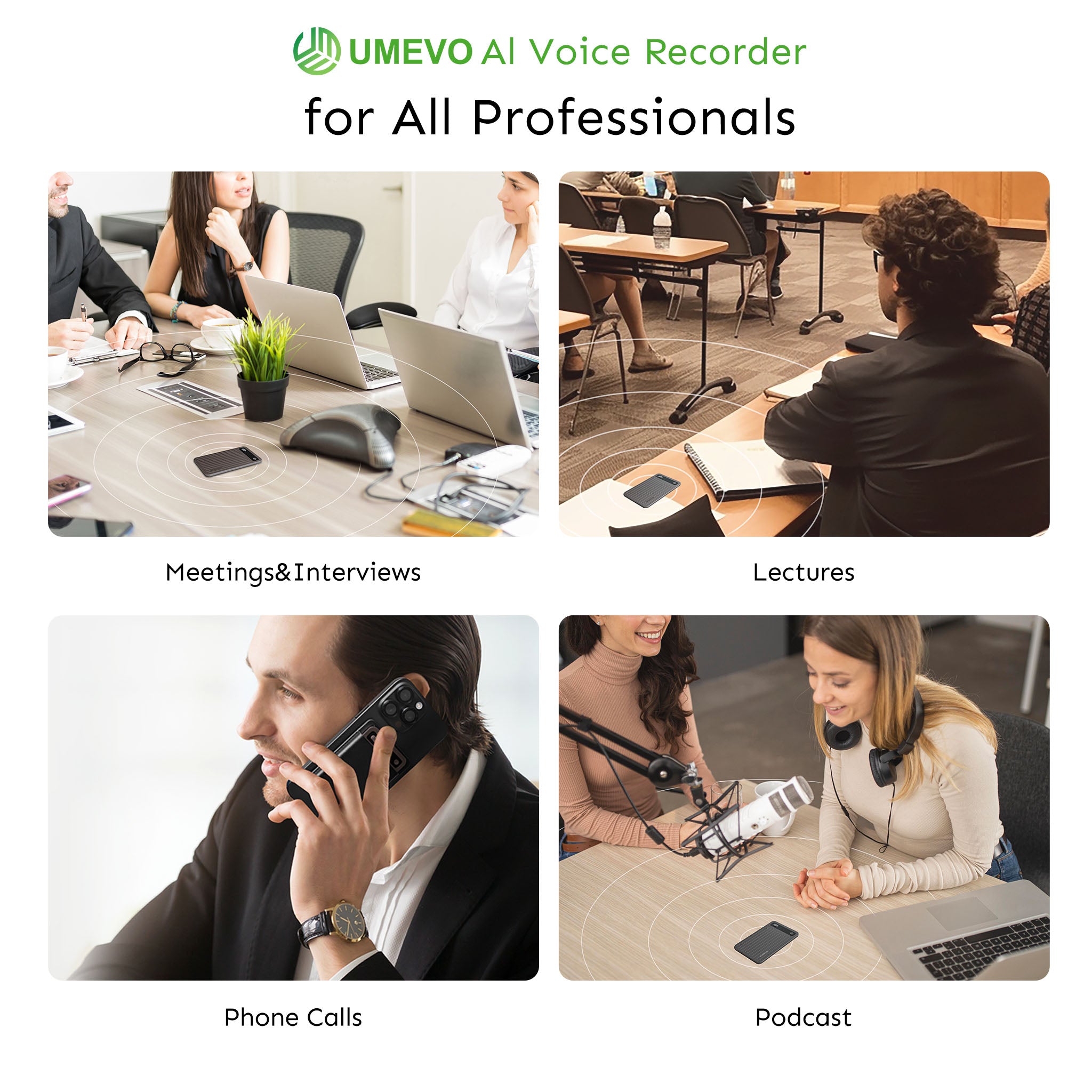
The UMEVO Note Plus exemplifies the hardware-first, low-recurring-cost approach to AI transcription for product research. Its vibration conduction sensor captures phone interviews by reading chassis vibrations rather than requesting OS permissions—a method grounded in the Penn State research on mechanical acoustic transmission. The dual-mode hardware switches between call recording and note recording with a single button press, covering the full range of interview formats product managers encounter.
The cost structure addresses the primary complaint voiced in community reviews: mandatory subscriptions that turn hardware purchases into recurring expense commitments. Free unlimited AI transcription for the first year, followed by 400 free minutes monthly and $0.59 top-ups, means the device remains functional without a subscription in perpetuity. For product teams evaluating three-year total cost of ownership against subscription models, the math favors one-time purchases at any research volume above five hours per month.
Explore the UMEVO Note Plus as a purpose-built recording solution for product teams: Magnetic Call Recorder with AI Transcription
Additional resources for product research workflows:
- UMEVO Note Plus App User Manual
- Best Smart Voice Recorder Guide
- Ultimate Guide to AI Voice Recorders and Meeting Summaries
Frequently Asked Questions
Q: Is it legal to record phone calls using a hardware vibration sensor?
The legality depends on jurisdiction, not on the recording technology. In one-party consent jurisdictions, recording is legal if you are a participant. In all-party consent jurisdictions, all participants must be informed. Because cross-border calls default to the strictest applicable law, the professional standard is to always request explicit consent before recording, regardless of the hardware method used.
Q: How does AI transcription handle technical product management jargon?
Accuracy depends primarily on audio input quality. Clean, high-fidelity recordings with good signal-to-noise ratios produce fewer errors on technical terms. For specialized vocabulary, custom summary templates can be configured to recognize product-specific language patterns, improving the relevance of generated summaries.
Q: Can one device handle both in-person and remote interviews?
Dual-mode hardware recorders with air-conduction microphones and vibration conduction sensors cover both scenarios. In-person interviews use the microphone array. Phone interviews use vibration sensing. For video calls on speakerphone, the air microphone captures room audio effectively.
Q: What happens after the first-year AI plan expires?
After the first year of unlimited AI transcription, users receive 400 free minutes per month (approximately four to five standard user interviews). Additional minutes are available through flexible top-ups at $0.59 per 120 minutes, with no mandatory annual subscription requirement.
Q: How do large audio files transfer from the device to a phone or computer?
Wi-Fi Direct enables fast file transfers that bypass Bluetooth bandwidth limitations. A one-hour recording transfers in under 30 seconds. The companion app manages the transfer and queues files for AI processing automatically.





0 comments