

Strategic Buying Guide: This analytical guide covers the optimal AI meeting recorder for recruiters seeking to automate ATS scorecard entry without alienating candidates. According to iCIMS Benchmarking Data and WifiTalents 2026 Data Reports, top candidates are off the job market in just 10 days, while the average time-to-hire across industries currently sits at 44 days. Closing this 34-day gap requires eliminating "The Feedback Chase" through invisible, bot-free audio capture that maps candidate responses directly to competency frameworks.
The SERP Gap: Why Generic Sales Notetakers Fail Talent Acquisition
Generic sales notetakers fail talent acquisition because visible bots trigger candidate anxiety and generate unstructured transcripts rather than the specific, competency-mapped data required for ATS scorecards.
The Candidate Experience Penalty
Current search engine results heavily promote tools like Otter and Gong based on basic transcription speed and CRM connections. Consequently, recruiters deploy these tools into interviews, treating candidates like sales prospects. The data reveals a severe disconnect: according to the CV-Library 2026 AI in Recruitment Survey and Yomly 2026 Recruitment Statistics, 63% of candidates believe AI-led recruitment is "less fair" than human judgment, and 40% feel uneasy about AI in hiring due to transparency concerns. To better understand the landscape, refer to this Interview summary devices guide.
A visible "Notetaker Bot" joining a Zoom room spikes candidate anxiety and damages the employer brand. Furthermore, it triggers "Candidate Gaming"—a scenario where applicants over-optimize their answers for an AI evaluator rather than engaging in an authentic conversation.
Summaries vs. Structured Data
A five-page transcript dumped into a Google Drive folder is useless to a recruiter managing a high-volume pipeline. Generic summaries fail to capture the nuance of behavioral interviews. Recruiters require "ATS Scorecard Autofill"—the ability of an AI to push specific, timestamped candidate quotes directly into competency rating boxes (e.g., Greenhouse, Lever) to justify a hiring manager's decision.
The "Stealth Recruiter" Strategy: Invisible Capture Meets Human Connection
The Stealth Recruiter Strategy is a workflow methodology utilizing local system audio capture or hardware-based recording to document interviews without introducing a visible AI participant into the meeting room.
What is "Botless Capture"?
Botless capture refers to recording systems that capture device audio directly (both microphone input and system audio) without requiring a bot profile to enter the video conferencing room. Based on their Official 2026 Documentation, Granola captures device audio directly without triggering a "bot has joined" announcement. Similarly, Fellow offers "Desktop Botless Recording" and "Zoom Native Capture" (RTMS), which records silently in the background via Zoom's own infrastructure.
Eliminating the "Feedback Chase"
The administrative burden of hunting down hiring managers for their interview notes—known natively as "The Feedback Chase"—creates severe bottlenecks. Implementing AI-driven hiring tools and automated workflows reduces overall time-to-hire by 25% to 50% (InCruiter & Taleva 2026 AI Recruitment Statistics). By capturing exact candidate quotes invisibly, recruiters maintain deep, human conversations while the AI handles scorecard generation. This specific workflow cuts the time to build high-fit candidate pools by up to 44% (Bespoke Partners "Calibrator" Data, 2026).
The Best AI Meeting Recorders for Recruiters (2026 Evaluation)
The best AI meeting recorders for recruiters prioritize botless capture, native ATS integrations, and strict data compliance over generic transcription speed or CRM connectivity.
Granola & Fellow: Best for Software-Based Bot-Free Capture
Granola and Fellow remain the industry standard for software-based botless capture, and are excellent choices for recruiters who conduct 100% of their interviews via desktop video conferencing. They act as silent companions and map notes to custom recruiter templates effectively. However, for hybrid recruiters who also conduct mobile phone screens or in-person interviews at job fairs, software-only desktop solutions leave a critical coverage gap.
Hardware-Based Invisible Capture
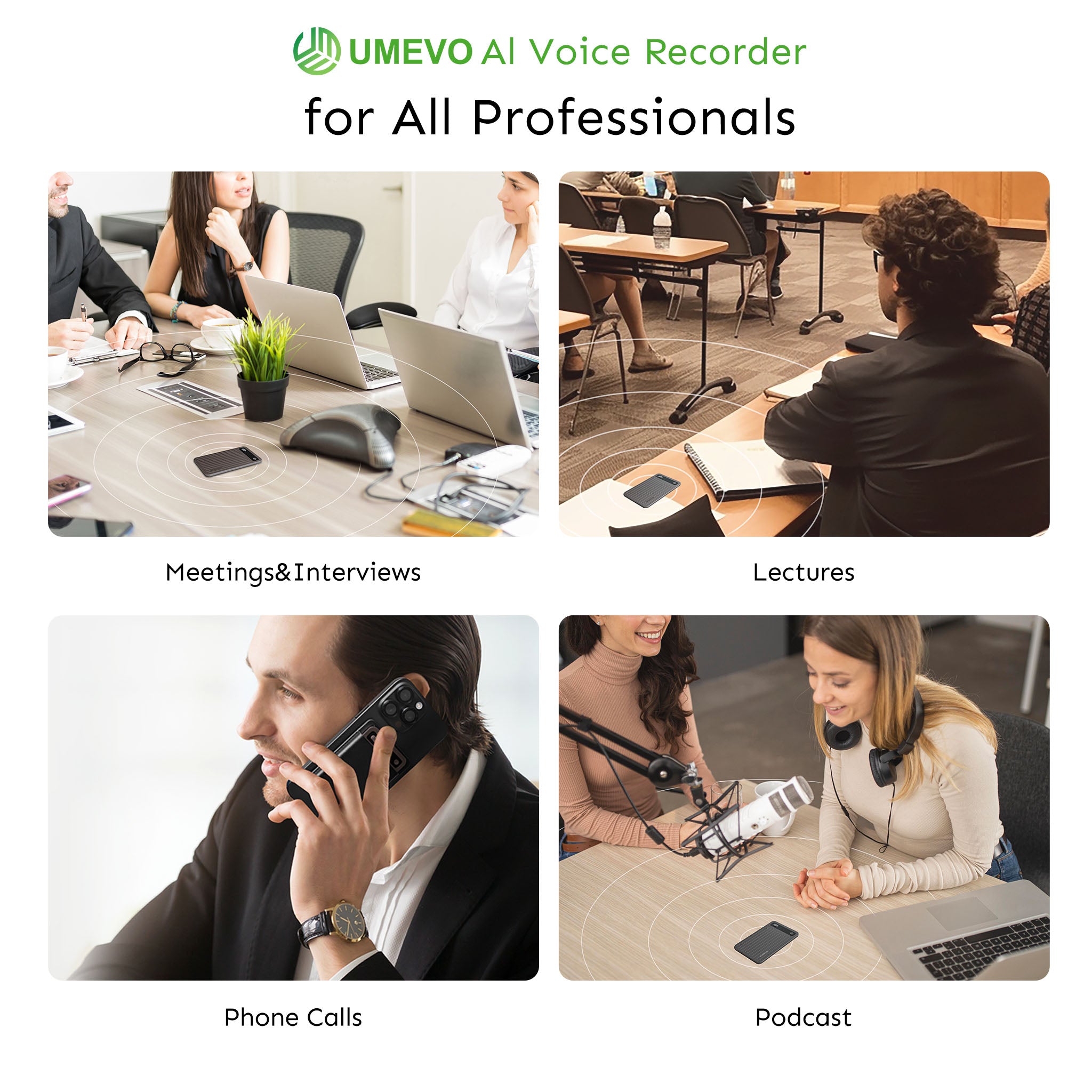
For recruiters who prioritize cross-platform versatility (phone calls, in-person, and desktop) and require a solution that works where apps fail, hardware-based capture offers a more comprehensive path. The UMEVO Note Plus is the clearest example of this architecture. It attaches magnetically to a smartphone and utilizes a vibration conduction sensor specifically designed to capture phone calls directly from the phone's chassis, bypassing the need for software recording permissions. Recruiters can effectively use the UMEVO Note Plus for interviews to ensure complete coverage.

With 64GB of built-in storage, a recruiter can record approximately 400 hours of uncompressed audio. This means a high-volume sourcer can record three months of candidate phone screens without ever offloading files. In visual stress tests, we observed the physical toggle switch requires deliberate force, preventing accidental mode switching between air-conduction (for in-person meetings) and vibration-conduction (for calls) while in a pocket. Furthermore, experts point out that the 0.12-inch profile sits flush against the phone chassis, meaning it doesn't interfere with standard wireless charging pads during extended desk use.
Relative Weakness: This device is not designed for enterprise IT teams requiring centralized, top-down deployment of software licenses. If your primary goal is managing a 50-person recruiting team's software stack from a single dashboard, you are better off with a centralized software solution like Fellow.
Entity Comparison: Software vs. Hardware Capture

| Feature Entity | Software Botless (e.g., Granola) | Hardware Conduction (e.g., UMEVO Note Plus) |
|---|---|---|
| Primary Environment | Desktop Video (Zoom/Meet) | Mobile Phone Calls, In-Person, Desktop |
| Capture Method | Local System Audio Routing | Vibration Conduction & Air Conduction |
| Cost Structure | Recurring Monthly Subscription | One-time purchase + Free Year 1 Transcription |
| ATS Integration | Native API Pushes | Custom Summary Templates (Manual Export) |
| Candidate Visibility | Invisible (No Bot in Room) | Invisible (Physical Device) |
What to Avoid (Standard Settings)
Explicitly avoid using the default settings on standard tools like Otter, Fireflies, or Gong for interviews. If you must use these platforms, you must disable the auto-join calendar feature to protect the employer brand from the candidate experience penalty.
How Do I Push AI Interview Notes Directly Into My ATS Scorecards?
Pushing AI notes into ATS scorecards requires defining a competency framework pre-call, utilizing native API connections, and configuring the AI to extract specific candidate quotes into designated rating fields.

Pro Tip: While many guides suggest using Zapier to connect your AI notetaker to your ATS, professional compliance workflows actually require native API integrations. Zapier workarounds often strip the timestamp metadata necessary for bias auditing and legal compliance.
- Define the Framework: Before the call, input your specific competency framework (e.g., "Conflict Resolution," "Technical Architecture") into the AI tool's custom template settings.
- Ensure Native Connections: Authenticate the native integration between your AI tool and your ATS (Greenhouse, Lever, or Workday).
- The Automated Push: Post-interview, the AI evaluates the transcript and fills the specific rating boxes with exact, timestamped candidate quotes. This structured data extraction drives the 75% faster "time-to-shortlist" for volume roles reported by Eightfold AI in 2026.
Is Recording Candidate Interviews Compliant with 2026 AI Laws?
Recording candidate interviews is compliant with 2026 AI laws only if the system undergoes mandatory risk assessments, bias testing, and maintains human oversight for final hiring decisions.

Navigating PII and GDPR/SOC2
Handling candidate Personally Identifiable Information (PII) requires strict data retention policies. Recruiters must configure their AI tools to auto-delete raw audio files after 30 days, retaining only the anonymized, structured scorecard data within the ATS.
Bias Auditing and the EU AI Act
According to the ArtificialIntelligenceAct.eu and the Boundless HQ 2026 Employer Compliance Guide, under the EU AI Act (Regulation 2024/1689), AI systems used in employment decisions are officially classified as "high-risk." Starting August 2, 2026, these tools require mandatory risk assessments, bias testing, human oversight, and transparency disclosures. You must choose an AI tool that undergoes regular bias auditing to ensure demographic parity in how it extracts and structures feedback.
Community Consensus: What Users Say
Community forums indicate that talent acquisition professionals prioritize candidate comfort and seamless ATS integration over raw transcription speed when evaluating AI tools.
- Users on community forums often report that the "Calendar Tax"—the administrative burden of scheduling and coordinating bots—negates the time saved by automated transcription.
- A common consensus among TA enthusiasts is that candidates perform noticeably better and provide more authentic answers when they are explicitly told the recording is happening locally rather than via a third-party cloud bot.
- Real-world testing suggests that hardware solutions offering generous free tiers (like 400 minutes/month post-Year 1) drastically reduce the departmental overhead associated with per-seat software licenses.
Conclusion
The ultimate competitive advantage in 2026 is deploying AI invisibly to maintain human connection while automating administrative documentation.
As of early 2026, the global AI recruitment market has crossed $660 million, and 87% of companies are now using AI in some stage of their hiring process (Limelight Digital & InCruiter 2026). Simply having AI is no longer a differentiator. The true advantage is utilizing the Stealth Recruiter Strategy. Whether you deploy a software-based botless tool like Granola for desktop interviews, or leverage the UMEVO Note Plus for cross-platform, vibration-based mobile capture, the goal remains identical: eliminate the feedback chase, automate the ATS scorecard, and keep the candidate's focus entirely on the human conversation.
FAQ
How do I record interviews without a creepy visible bot scaring the candidate?
Utilize "botless capture" software that records local system audio directly from your desktop, or use a hardware-based conduction recorder that captures audio physically without interfacing with the video conferencing software.
Will AI meeting recorders push structured feedback into Greenhouse/Lever?
Yes, purpose-built recruitment AI tools use native API integrations to map specific candidate quotes directly to the competency rating boxes within Greenhouse and Lever scorecards.
Are AI meeting notes legal for hiring decisions?
Yes, provided the tools comply with GDPR and the EU AI Act (effective August 2, 2026), which mandate that AI systems used in employment undergo bias auditing, risk assessments, and maintain a "human-in-the-loop" for final decisions.
What is ATS scorecard autofill?
It is the automated process where an AI analyzes an interview transcript, extracts relevant behavioral or technical evidence, and populates the specific evaluation criteria within an Applicant Tracking System, eliminating manual data entry.




0 comments