
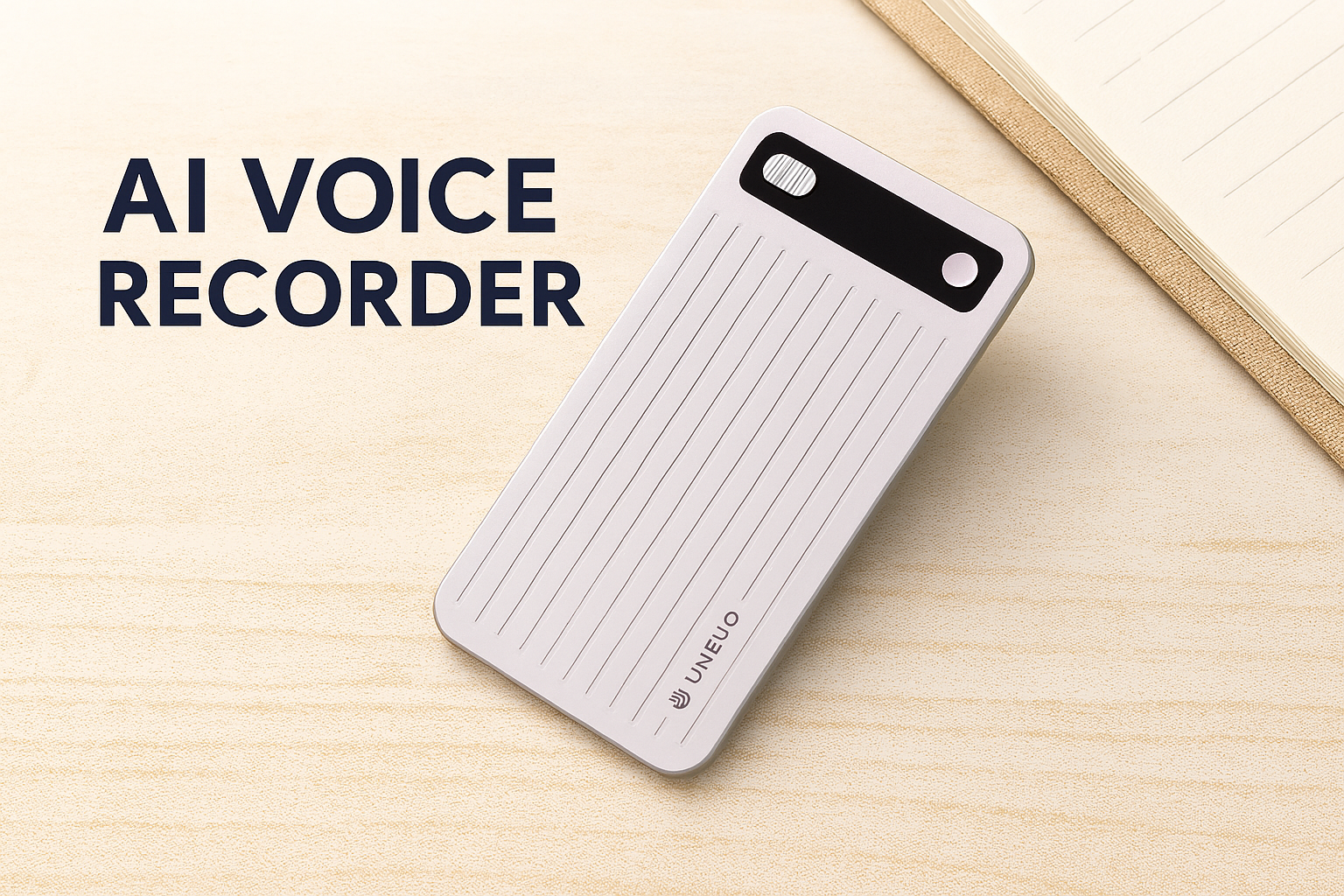
Quick answer: UMEVO Note Plus is a practical PLAUD alternative when your priorities are a lower current hardware price, more included transcription in the first year, 64GB local storage, and one device for both calls and in-person conversations. PLAUD Note remains the stronger choice when you value the broader PLAUD app, web, desktop, template, and integration ecosystem. PLAUD Note Pro is the better fit for larger rooms or users who specifically need its published microphone array, longer Endurance mode, display, and automatic mode switching.
UMEVO Note Plus is not a replacement for a PLAUD device. It is an alternative for overlapping recording jobs. Switching changes the companion app, account, cloud library, AI features, subscription rules, accessories, and export workflow. Compare the complete path from pressing Record to delivering a usable transcript—not only the recorder’s purchase price.
Publisher disclosure: UMEVO publishes this article and sells UMEVO Note Plus. This comparison uses current manufacturer pages and support documentation rather than an independent laboratory or long-term hands-on test. PLAUD and UMEVO specifications, US prices, promotions, and plans were checked on August 7, 2026 and may change. Confirm the linked official pages before purchasing.
PLAUD Alternatives: The Quick Verdict
| If your priority is... | Best starting point | Why |
|---|---|---|
| Lower current hardware price and high first-year transcription volume | UMEVO Note Plus | Currently listed at $149 with one year of the Max plan included |
| A developed cross-device software ecosystem | PLAUD Note | PLAUD App, Web, and Desktop access, plus its template and automation workflow |
| Calls and everyday meetings without paying for Pro hardware | PLAUD Note | Manual dual-mode recording, 64GB storage, and the free Starter plan |
| Larger rooms and stronger published pickup hardware | PLAUD Note Pro | Four MEMS microphones, one VPU, up to 5m pickup in Enhance mode, and a display |
| Up to 400 transcription minutes per month after the included first year | UMEVO Note Plus Starter | Its current product page lists 400 free minutes per month from Year 2 |
| Team administration and the PLAUD ecosystem | PLAUD Team | PLAUD publishes centralized billing, user, seat, device, and offboarding controls |
The right answer depends on recording environment and software workflow. UMEVO is not automatically better because it costs less, and PLAUD Note Pro is not automatically better because it has more microphones. Start with the specific constraint you need to solve.
Why Look for a PLAUD Alternative?
People searching for “PLAUD alternative” usually have one of five concerns:
- Transcription allowance: the free monthly quota may be too small for frequent meetings, lectures, interviews, or calls.
- Ongoing cost: hardware price is only the first part of the total cost.
- Recording environment: a quiet one-to-one call and a large conference room need different capture hardware.
- Workflow ownership: switching services means moving to a different app, cloud library, template system, and export process.
- Device preference: some users want manual controls and predictable modes, while others prefer automatic switching and a display.
A genuine comparison should answer those questions directly. It should not create fictional user stories, claim one device has universally better accuracy, or label a lower-priced product an “upgrade” without explaining what the buyer gives up.
How We Evaluated These PLAUD Alternatives
This guide compares official published information in six categories:
- current US hardware price;
- recording modes, storage, battery, microphones, and published pickup range;
- free and paid transcription allowances;
- language, summary, speaker, template, and export features;
- app, web, desktop, and team workflow; and
- limitations that cannot be resolved from specifications alone.
Manufacturer specifications are useful for creating a shortlist, but they are not a controlled audio-quality test. Room acoustics, speaker distance, phone cases, Bluetooth routing, accents, crosstalk, background noise, and app processing can materially affect the result. Test the complete workflow during the return period.
UMEVO Note Plus vs PLAUD Note and Note Pro

| Feature | UMEVO Note Plus | PLAUD Note | PLAUD Note Pro |
|---|---|---|---|
| Current US list price | $149 | $159 | $189 |
| Weight | 30g | 30g | 30g |
| Local storage | 64GB | 64GB | 64GB |
| Published continuous recording | Up to 40 hours | Up to 30 hours | Up to 30 hours in Enhance mode or 50 hours in Endurance mode |
| Published standby | Up to 60 days | Up to 60 days | Up to 60 days |
| Meeting and phone-call modes | Manual NOTE/CALL switch | Manual dual-mode selector | Smart dual-mode switching |
| Published microphones and pickup | No directly comparable microphone count or pickup distance published | 2 MEMS + 1 VPU; 2–3m published range | 4 MEMS + 1 VPU; up to 5m Enhance or 3m Endurance |
| Transcription languages | 140+ | 112 | 112 |
| Free transcription | Current offer: first-year Max plan; then 400 minutes/month on Starter | 300 minutes/month on Starter | 300 minutes/month on Starter |
| Companion workflow | AI DVR Link app | PLAUD App, Web, and Desktop | PLAUD App, Web, and Desktop |
| Display | Status display | No display | AMOLED status display |
Important: These devices are alternatives, not interchangeable products. Their recordings, subscriptions, AI libraries, templates, share links, and device accessories live in different ecosystems. Confirm export options and preserve any files you need before switching.
Hardware Price Is Only the First Cost
At the time of this review, the official US pages list UMEVO Note Plus at $149, PLAUD Note at $159, and PLAUD Note Pro at $189. Promotions, taxes, bundles, currencies, and regional availability can change those figures.
The $10 gap between UMEVO Note Plus and PLAUD Note is less important than the transcription plan if you regularly process long recordings. A buyer who stays within a free allowance may never need a paid plan. A high-volume user can spend more on AI processing than the initial hardware difference.
Do not compare “hardware plus one included year” with “hardware only” as if they are the same offer. Estimate your monthly transcription hours, identify the AI functions you actually need, and compare at least a two-year horizon.
PLAUD and UMEVO Transcription Plans Compared
The current PLAUD AI plan page lists:
- Starter: free, 300 transcription minutes per month;
- Pro: 1,200 minutes per month, currently $8.33 per month billed annually or $17.99 billed monthly; and
- Unlimited: transcription capped at 24 hours per day, currently $19.99 per month billed annually or $29.99 billed monthly.
PLAUD’s transcription-minute documentation says unused monthly minutes do not roll over. Recording can continue after the quota is exhausted, but transcription pauses until the allowance resets, the user adds minutes, or the plan is upgraded.
The current UMEVO Note Plus product page lists one year of the Max plan with unlimited transcription as part of the current purchase offer. From Year 2, it lists 400 free minutes per month on Starter, annual-billing equivalents of $2.50 per month for Pro and $5.83 per month for Max, and optional minute packs.
Plan names do not prove feature parity. Compare speaker tools, templates, AI models, export formats, sharing, storage, integrations, and data handling—not just the word “unlimited.”
Recording Hardware and Room Size
PLAUD publishes the clearest hardware distinction. Its current Note versus Note Pro support table lists two MEMS microphones and one VPU for PLAUD Note, compared with four MEMS microphones and one VPU for Note Pro. It lists a 2–3m range for Note and up to 5m in Note Pro’s Enhance mode.
UMEVO’s current product page does not provide a directly comparable microphone count or pickup-distance specification. That means this article cannot honestly conclude that UMEVO has better room pickup than either PLAUD model. Buyers who record large conference rooms should prioritize a consented trial in their actual space.
For close-range interviews, phone-attached recording, personal voice notes, and small meetings, maximum published range may not be the deciding factor. Physical controls, battery, file transfer, transcription allowance, and the quality of the final notes can matter more.
Battery and Storage Comparison
All three devices publish 64GB of local storage and weigh 30g. Their published recording endurance differs:
- UMEVO Note Plus: up to 40 hours;
- PLAUD Note: up to 30 hours; and
- PLAUD Note Pro: up to 30 hours in Enhance mode or 50 hours in Endurance mode.
Note Pro’s longest figure comes with a different operating mode and a reduced published pickup range of 3m. “Up to” battery claims depend on configuration, environment, battery condition, and use. Recharge before critical sessions and test the selected mode instead of treating the maximum as guaranteed.
Phone Calls and In-Person Meetings
UMEVO Note Plus and PLAUD Note both use manual modes for phone-attached and in-person recording. PLAUD Note Pro adds automatic dual-mode switching. Manual control is useful when you prefer to know exactly which mode is active; automatic switching can reduce setup steps when moving between calls and rooms.
Phone-call capture can depend on phone model, case, placement, volume, and audio routing. Test both speakers before relying on any recorder for an important call. A magnetic recorder also does not create permission to record. Review the voice call recording law and consent guide, inform participants, and follow the rules that apply to the call.
Software and AI Workflow

PLAUD’s strongest differentiator is its documented software breadth. Its current product and plan pages describe PLAUD App, Web, and Desktop access, 10,000+ templates, speaker labels, custom vocabulary, Ask PLAUD, AutoFlow, sharing, export, and integrations. Feature access can depend on the plan.
UMEVO Note Plus uses the AI DVR Link app. The current UMEVO Note Plus manual documents device binding, file synchronization, transcription, summaries, mind maps, speaker identification, Ask AI, sharing, and multiple export options.
A feature list does not tell you which interface you will prefer. Before switching, test how quickly you can:
- start a recording and confirm its status;
- transfer a long file;
- identify speakers and correct names;
- create the summary format you need;
- export audio, transcript, and notes;
- find an older conversation; and
- delete files and shared links.
Language Support Is Not the Same as Accuracy
UMEVO currently publishes support for 140+ transcription languages, while PLAUD publishes 112. A larger language count may matter for multilingual users, but it does not establish higher accuracy in a particular language, accent, or acoustic environment.
Neither manufacturer’s marketing claim should replace a test using your own speakers, vocabulary, noise level, and recording distance. Verify names, figures, technical terms, action items, and quotations against the original audio. AI transcripts and summaries are working documents, not guaranteed verbatim records.
Privacy, Storage, and Compliance Questions
A recorder can store audio locally while its AI features still require an app or cloud service. Ask where audio, transcripts, summaries, speaker labels, and shared links are processed and retained. Review account deletion, export, vendor access, model-training terms, and organization-specific controls.
Do not infer that a complete workplace, healthcare, legal, or financial workflow is compliant because a product page lists security standards. Compliance depends on the organization’s contracts, configuration, access, retention, consent, and use. In regulated work, involve the appropriate privacy, security, legal, and records teams before adoption.
What Changes When Switching from PLAUD to UMEVO?
Before moving to a different recorder ecosystem:
- Export the PLAUD audio, transcripts, notes, and summaries you must retain.
- Check whether folders, templates, speaker names, highlights, and shared links can be reproduced.
- Review subscription cancellation and renewal dates.
- Test UMEVO recording, synchronization, transcription, correction, export, and deletion.
- Confirm magnetic attachment with your phone and case.
- Run representative calls, interviews, and rooms during the return period.
- Document consent, retention, and access rules for the new workflow.
Keep the old system available until the new workflow has passed a real end-to-end test. Avoid creating multiple uncontrolled cloud copies during migration.
Other Types of PLAUD Alternatives
UMEVO Note Plus is not the only kind of alternative. The right category depends on the job:
- Software-only meeting assistants can be a better fit when every conversation happens in supported online meeting platforms.
- Phone-native recording and transcription may be enough for occasional personal use on supported devices and regions.
- Wearable recorders suit hands-free, in-person capture but may not provide the same phone-call workflow.
- Traditional digital recorders can prioritize audio controls and removable media over AI notes.
- Enterprise calling platforms are more appropriate when teams need centrally managed recording, consent, access, and retention.
Do not buy dedicated hardware simply because it appears in an alternative roundup. First decide whether you need a physical capture device at all.
Choose UMEVO Note Plus If...
- the current $149 price and included first-year Max plan improve your total cost;
- 400 free minutes per month after Year 1 better matches your ongoing usage;
- you want a manual NOTE/CALL mode switch;
- up to 40 hours of published recording time is useful;
- you need the languages or AI DVR Link outputs documented by UMEVO; and
- you have tested the recorder and app in your actual workflow.
Choose UMEVO for those specific advantages—not because a publisher-owned comparison calls it best for every buyer.
Choose PLAUD Note If...
- PLAUD App, Web, Desktop, templates, custom vocabulary, and integrations matter more than included transcription volume;
- 300 free minutes per month cover your needs;
- you want a documented 2–3m pickup range and published microphone configuration;
- you already have recordings, templates, or team processes in PLAUD; or
- the $159 hardware price fits your budget.
PLAUD Note is the logical baseline for calls and everyday meetings inside the PLAUD ecosystem.
Choose PLAUD Note Pro If...
- you frequently record larger rooms;
- four MEMS microphones, one VPU, and the published 5m Enhance-mode range address a real need;
- you want an AMOLED status display;
- automatic dual-mode switching reduces friction; or
- up to 50 hours in Endurance mode matters more than its reduced pickup range.
Note Pro uses the same PLAUD subscription structure as Note. Paying more for hardware does not automatically add more monthly transcription minutes.
Comparison Limitations You Should Know
This article compares current published specifications and workflows. It does not claim:
- that one device has universally higher transcription accuracy;
- that manufacturer battery figures will be reached in every condition;
- that UMEVO’s unpublished microphone count or pickup range matches PLAUD;
- that a security certification makes every customer workflow compliant;
- that AI summaries replace review of the recording; or
- that a recorder may be used without appropriate notice and consent.
Prices and plans are particularly changeable. Use the source-check date as context and open the official pages before placing an order.
PLAUD Alternatives FAQ
What is the best PLAUD alternative?
There is no universal best alternative. UMEVO Note Plus is worth considering when lower current cost and included transcription volume are priorities. Software-only tools, phone-native features, wearables, and traditional recorders may be better for other workflows.
Can UMEVO Note Plus replace PLAUD Note?
It can cover similar phone-call and in-person recording jobs. However, UMEVO uses AI DVR Link, different plans, different AI features, and a separate file library. Export required PLAUD data and test the full UMEVO workflow before switching.
Is UMEVO Note Plus cheaper than PLAUD Note?
As checked on August 7, 2026, the official US pages list UMEVO Note Plus at $149 and PLAUD Note at $159. Promotions and regional prices can change. The larger cost difference may come from the transcription plan rather than the $10 hardware gap.
Does PLAUD require a subscription?
No paid subscription is required to start. Each PLAUD device currently includes the free Starter plan with 300 transcription minutes per month. Pro and Unlimited plans add more transcription capacity and features.
How many free transcription minutes does UMEVO include?
The current UMEVO Note Plus offer includes the Max plan for the first year. From Year 2, the product page lists 400 free transcription minutes per month on Starter. Confirm the offer at purchase because plan terms can change.
Which recorder is better for large meetings?
PLAUD Note Pro has the strongest disclosed large-room hardware in this comparison: four MEMS microphones, one VPU, and up to 5m pickup in Enhance mode. UMEVO does not publish a directly comparable pickup distance, so a precise claim that it performs better would be unsupported.
Can these record phone calls?
All three manufacturers publish phone-attached and in-person recording workflows. Compatibility and quality can depend on the phone, case, placement, and call setup. Obtain required consent and test both speakers before an important call.
PLAUD Alternatives: Bottom Line
Choose UMEVO Note Plus when the current $149 price, included first-year Max plan, 400-minute Year-2 Starter allowance, manual call and meeting modes, and up to 40 hours of published recording time fit your workflow.
Choose PLAUD Note when the PLAUD software ecosystem and a documented everyday capture configuration matter more than the difference in included transcription. Choose PLAUD Note Pro when larger-room pickup, the display, automatic mode switching, or Endurance mode solves a specific problem.
The strongest buying process is simple: estimate transcription hours, identify the largest room, test phone-call attachment, compare exports and AI outputs, review data handling, and use the return period for a real end-to-end trial.


0 comments